

Subgenus: Dermestinus
These are the dichotomous keys to identify species of Dermestes (Coleoptera; Dermestidae) on a worldwide scale.
Click on the name of the species group to proceed with the key guide. Click here to go back to the main page.
1a. Majority of the pronotum, the scutellum and about 1/4th of the upper part of the elytra are uniformly covered in light yellowish hairs and the rest of the elytra are black. The border between the two colours is a distinct wavy line. Go to species group: dimidiatus
1b. Different pattern and/or colour hairs. Go to question: 2
2a. Pronotum is black with white to brown hairs uniformly covering the lateral margins in a certain shape, the hairs are all directed posteriorly; the pronotal disc tends to be mostly black. Go to species group: maculatus
2b. The hairs on the pronotum are in a different pattern, for example fully covering, mottled or tufts of hair going in different directions. Go to question: 3
3a. Lower half of the elytra only contain black hairs; pronotum is covered in brown/yellowish orange hairs intermixed with black hairs; hairs on the pronotum are all directed posteriorly. Go to species group: elegans
3b. Lower half of the elytra also contain other colour hairs / if only black hairs are present on the lower half of the elytra, then the hairs on the pronotum are oriented in multiple directions and not only posteriorly. Go to question: 4
4a. Anterior 1/3 th of elytra are predominantly covered with whitish hairs that seem to create some sort of a band. Go to species group: marmoratus
4b. Anterior 1/3 th of elytra are covered in black or brown hairs or with irregular patches of black, brown and/or whitish hairs. Go to question: 5
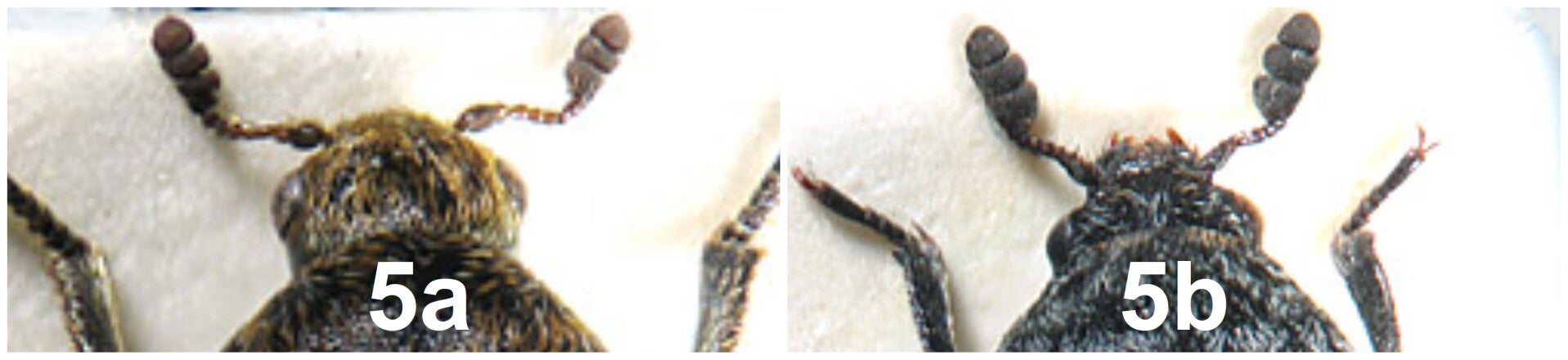
5a. The antennal club is shorter in length than the other antennal segments combined. Go to question: 6
5b. The antennal club is equal or longer in length to the remaining antennal segments. Go to species group: murinus
6a. Middle of the hind femora with a patch or band of white hairs; the elytra are covered in black hairs intermixed with predominantly white hairs (some brown hairs may be present). Go to species group: gyllenhalii
6b. The hind femora do not contain a patch or band of white hairs / if the hind femora contain a patch or band of white hairs, then the elytra are covered in black hairs intermixed with white and brown hairs . Go to species group: laniarius




Made by Sarah Mahie
Created on: 30-12-2025
Latest update: 27-02-2026