

Species group: murinus
These are the dichotomous keys to identify species of Dermestes (Coleoptera; Dermestidae) on a worldwide scale.
Click on the species names to go to their taxon page. Click here to go back to the subgenus page. Click here to go back to the main page.
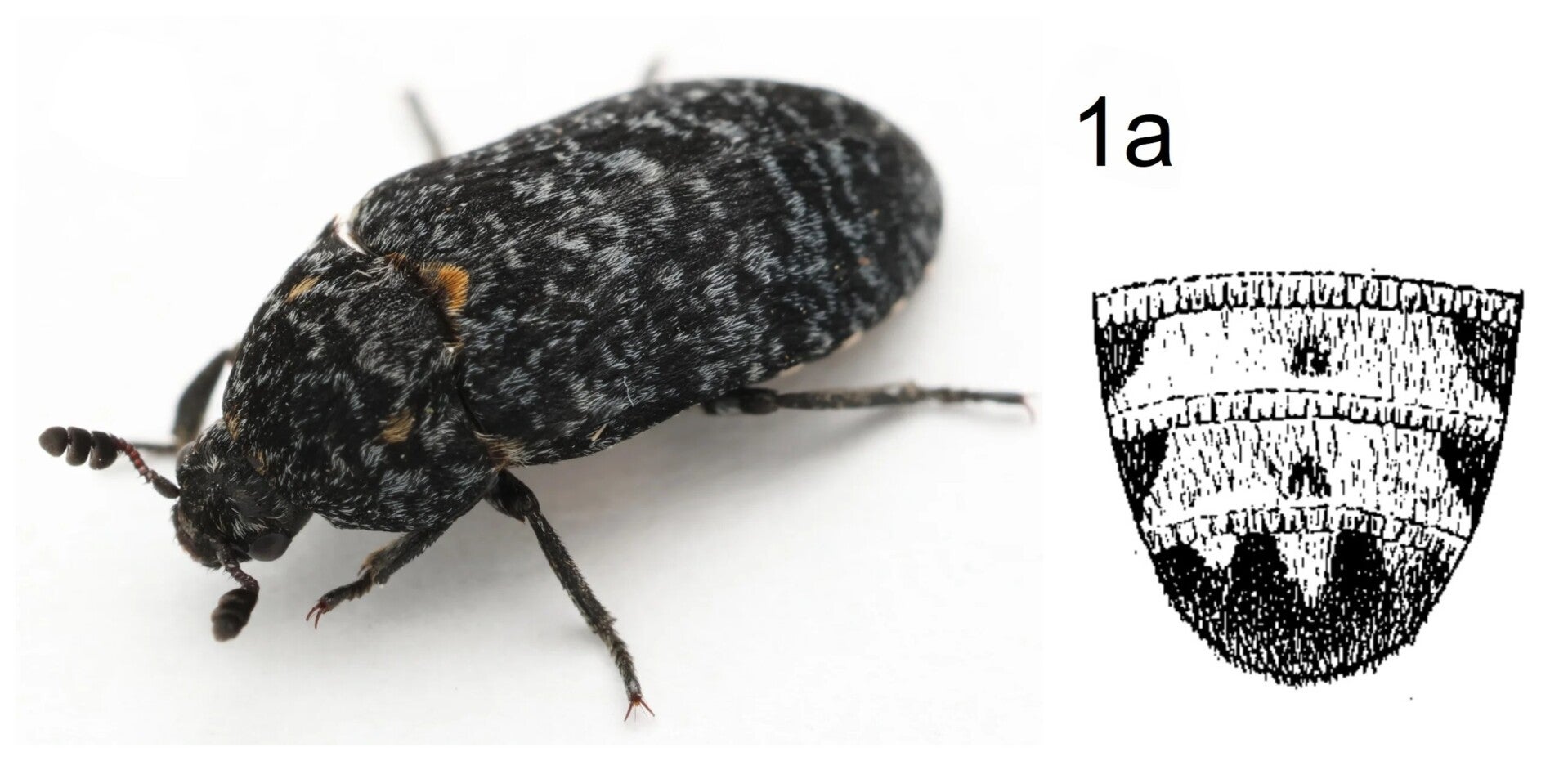
1a. The hairs on the pronotum and elytra are similar in colour, without yellow hairs with the exception of two small yellow spots on the pronotum and some yellow hairs on the margins of the pronotum.
→ Dermestes murinus
1b. More brown hairs present on the pronotum . Go to question: 2
2a. Three small spots of white hairs are present around on the pronotum around the coronal midline; the abdomen are covered in dark brown hairs with a big patch of white hairs in the middle of the first two sternites.
→ Dermestes rattus
2b. The prontoum and the abdomen are covered in a different pattern and/or colour hairs. Go to question: 3
3a. The black spots on the pronotum are defined; body longer than 7 mm long and convex in shape; males have one tuft on their abdomen (4th abdominal sternite). Go to question: 4
3b. There are no defined black spots on the pronotum; body shorter than 8 mm long; males have two spots on their abdomen (3th and 4th abdominal sternite). Go to question: 5
4a. Last abdominal sternite black with two subtriangular white spots at the anterior margin that may or may not reach the posterior margin; shape of the male genitalia.
→ Dermestes pardalis
4b. Last abdominal sternite black with two small white spots anteriorly; shape of the male genitalia.
→ Dermestes havai
5a. Elytra are uniformly covered in hairs; last abdominal sternite with a white transverse spot at the base (almost) reaching the posterior margin in the middle. Go to question: 6
5b. Last andominal sternite with two small white spots at the anterior margin. Go to question: 8
6a. The abdomen are honey-yellow and covered with yellow hairs with brown spots; the anterior corners of the first abdominal sternite are covered in light hairs; the elytra are covered in in black hairs, in males intermixed with white-yellow hairs along suture; the shape of the male genitalia; each elytron with one small humeral spot of long yellow hairs; the shape of the brown spots at the apex of the last abdominal sternite are very variable in shape.
→ Dermestes nan
6b. The abdomen are black and covered in with hairs with black spots; the anterior corners of the first abdominal sternite are covered in black hairs; the elytra are covered in black hairs intermixed with white hairs; shape of male genitalia. Go to question: 7
7a. The pronotum irregularly covered in yellow hairs, so the black of the pronotum is visible in places; first ventral segment with noticeable dark spots under the legs that are close to or connected with the spots on lateral edge; shape of the black spots at the apex of the last abdominal sternite, the white hairs end semi circular near the posterior margin of the sternite (except in kaliki variation).
→ Dermestes tessellatocollis
7b. The pronotum is equally dense covered everywhere in golden-yellow hairs that form tufts, the black pronotum is barely visible; dark spots under the legs, with distinct black spots present only on the lateral edge; shape of the black spots at the apex of the last abdominal sternite, the white hairs end semi triangular near the posterior margin of the sternite.
→ Dermestes fulvicollis
8a. Spots of brown hairs are present as randomly located spots on the elytra; pronotum can be covered mostly in grey hairs, mostly in brown hairs or have a mix of the two colours.
→ Dermestes talpinus
8b. The division of brown and grey hairs is more clear, there are no brown hairs on the elytra besides the anterior margins; the pronotum is covered mostly in brown hairs. Go to question: 9
9a. Large spots of black hairs on the margin of the second abdominal sternite that are surrounded by white hairs; shape of male genitalia.
→ Dermestes smithi
9b. No spots of black hairs on the margin of the second abdominal sternite; shape of male genitalia. Go to question: 10
10a. Shape of male genitalia.
→ Dermestes algeriensis
10b. Shape of male genitalia.
→ Dermestes undulatus


Extra information:
The regular form of Dermestes murinus is found in the Paleartcic region. The colour variant D. murinus auriceps is found in North Korea, Mandzhuria, Mongolia and Russia and is characterized by its head that is totally covered in yellow hairs.
The regular form of D. rattus is found in the middle and Western States of the USA and is characterized by elytra with nearly all white hairs with small, irregular patches of black or dark brown hairs. The colour variant D. rattus tristis appears more towards to coastline instead of inland, for example in Baja California Norte, Mexico, in San Francisco, USA, and in Thompson-Nicola, Canada. This variant is characterized by elytra with all black or dark brown hairs or all dark hairs except for few intermingled white or golden white hairs.

The species Dermestes tessellatocollis has a variation called "kaliki". This time the difference between the regular form and the variety is ventral instead of dorsal: the shape of the white pattern on the last abdominal sternite. In D. tessellatocollis var. kaliki, the white pattern does not reach the apical margin of the sternite.


As you might notice, Dermestes fasciventris (from the elegans species group) looks dorsally a lot like D. nan, D. tessellatocollis and D. fulvicollis. All these species have brown hairs on the pronotum and their elytra are uniformly covered with black hairs (altough with some white hairs intermixed, except in the females of D. nan). The biggest difference between D. fasciventris and the three species of the murinus species group is the direction of the hairs on the pronotum. In the species D. fasciventris, the hairs are all directed posteriorly. In the other three species, different sections of hairs are oriented in different directions on the pronotum.
In the United States and in Canada, both Dermestes talpinus and D. undulatus can be found. The two species can be differentiated from each other by question 8 of the key guide above. Besides the dorsal pattern, it is also possible to identificate the species based on the ventral pattern. In D. talpinus, the lateral black spot of the second abdominal sternite is not connected to the black spot of the first abdominal sternite. In D. undulatus, these two black spots are connected.
Another difference between these two species can be found in the pronotal pubescence. D. talpinus has two yellow spots, brighter than the other yellow hairs present on the pronotum, just behind the head at the anterior margin of the pronotum. D. undulatus lacks these two bright yellow spots.


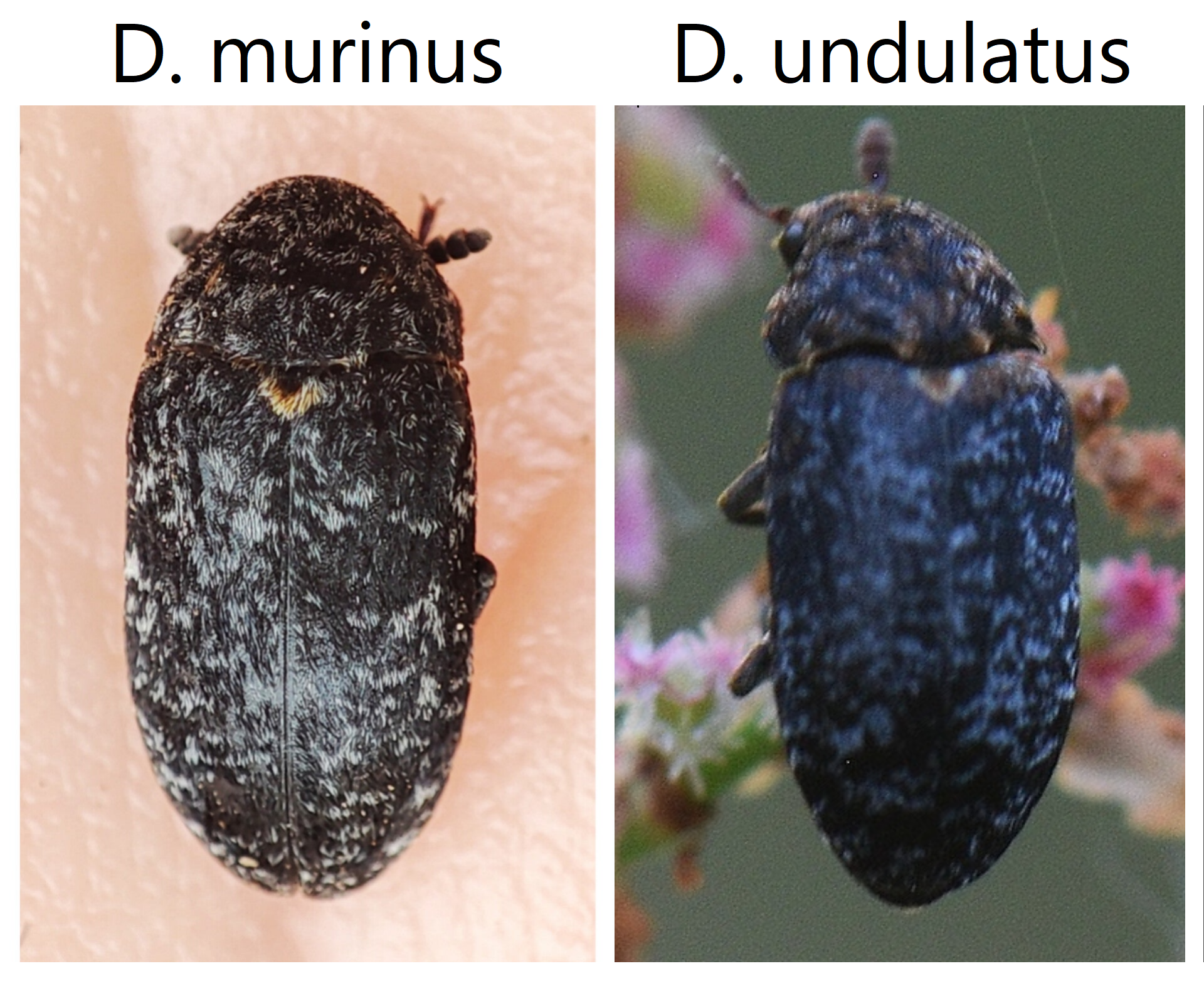
Dermestes murinus and D. undulatus coincide in Eruope. Most often they can be differiantated easily dorsally by the colour of the pronotal pubescence (and note the two small spots of yellow hairs on the pronotum of D. murinus). However, they also differ in ventral pattern. In D. murinus, the last abdominal sternite has a small median longitudinal white stripe adjacent at the anterior edge. In D. undulatus, the last abdominal sternite has a small median longitudinal white stripe adjacent at the posterior edge. The black lateral spots on the first and second abdominal sternite aren't connected.
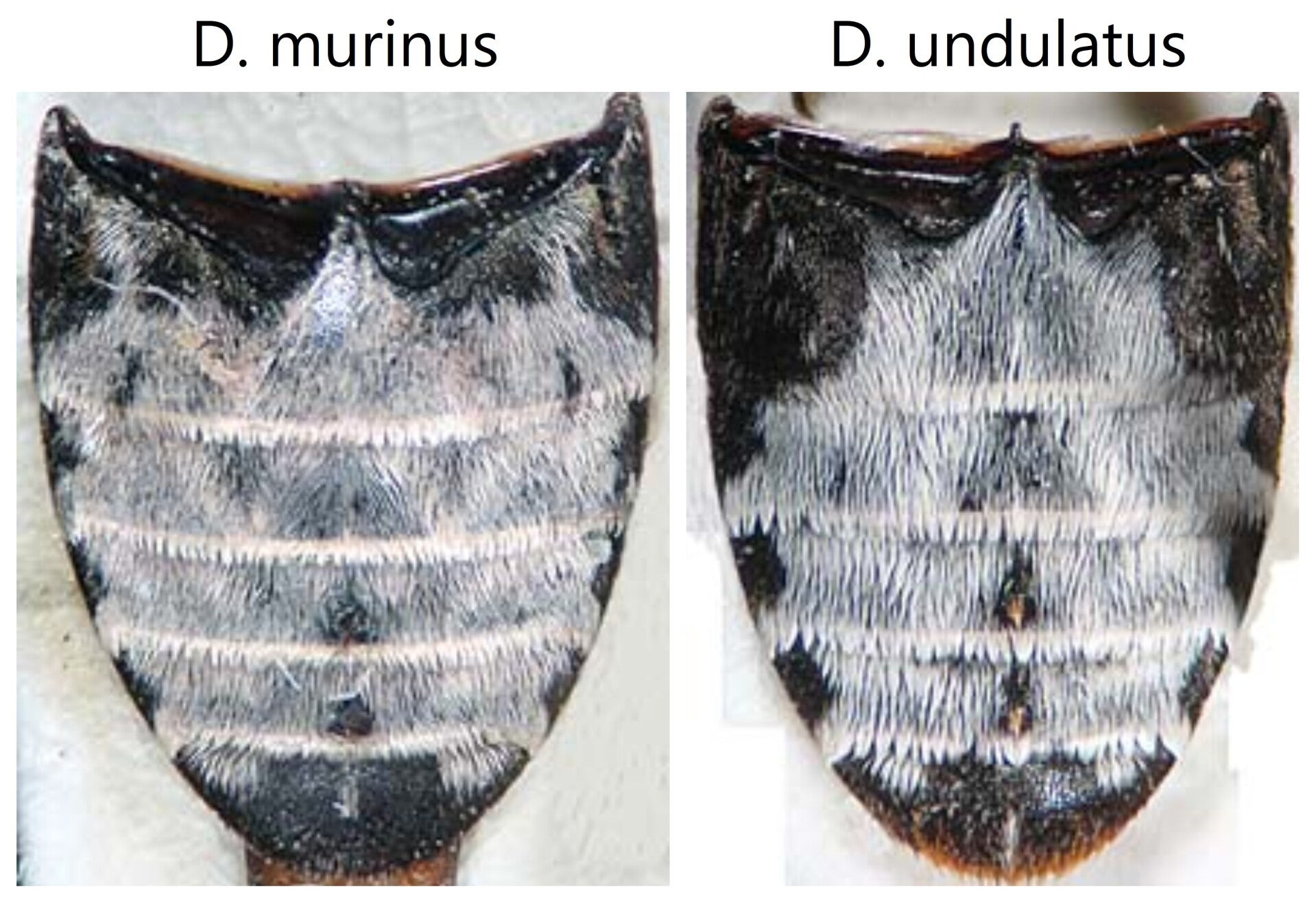
Photo gallery:
Dermestes murinus:
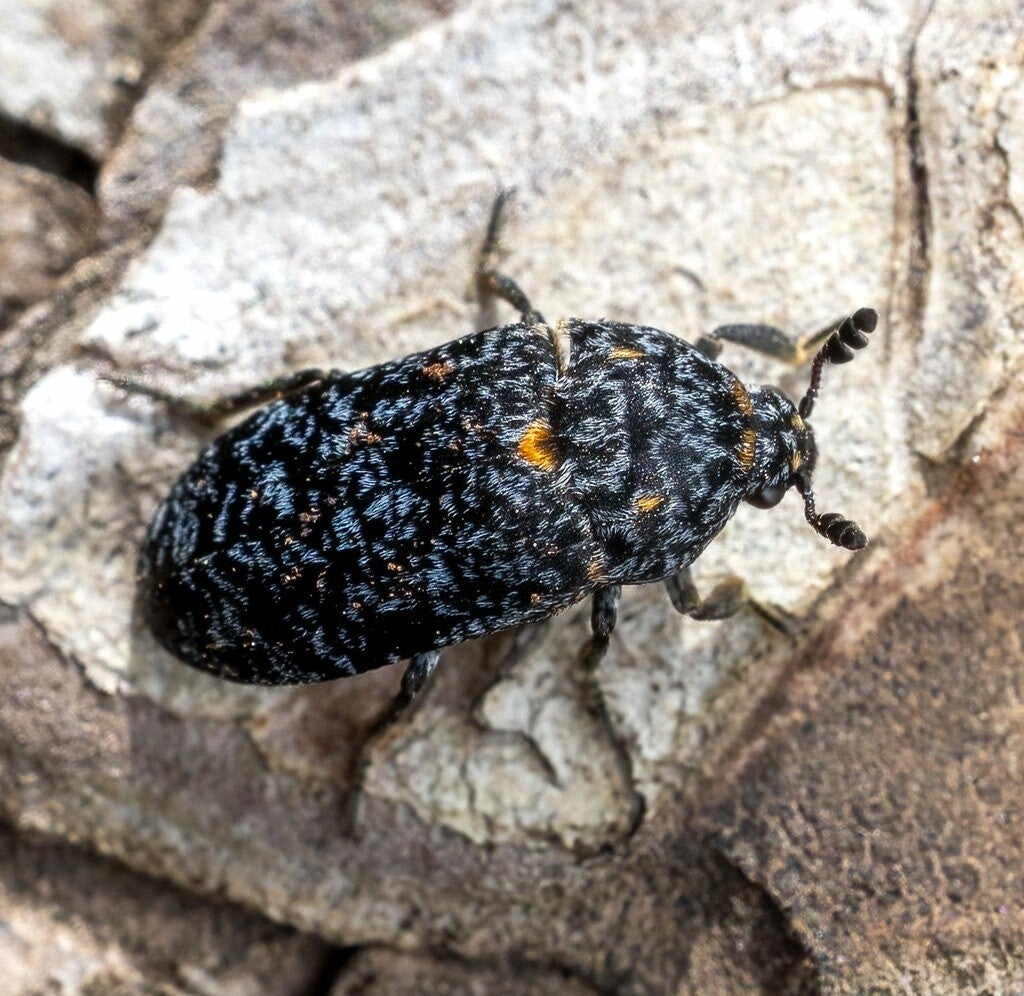
Dermestes talpinus:

Dermestes undulatus:

Dermestes nan ♀:

Dermestes tesselatocollis:

Dermestes pardalis:

Made by Sarah Mahie
Created on: 30-12-2025
Latest update: 18-07-2026