

Species group: maculatus
These are the dichotomous keys to identify species of Dermestes (Coleoptera; Dermestidae) on a worldwide scale.
Click on the species names to go to their taxon page. Click here to go back to the subgenus page. Click here to go back to the main page.
1a. Apex of elytra with spine. Go to question:2
1b. Apex of elytra without spine. Go to question: 4
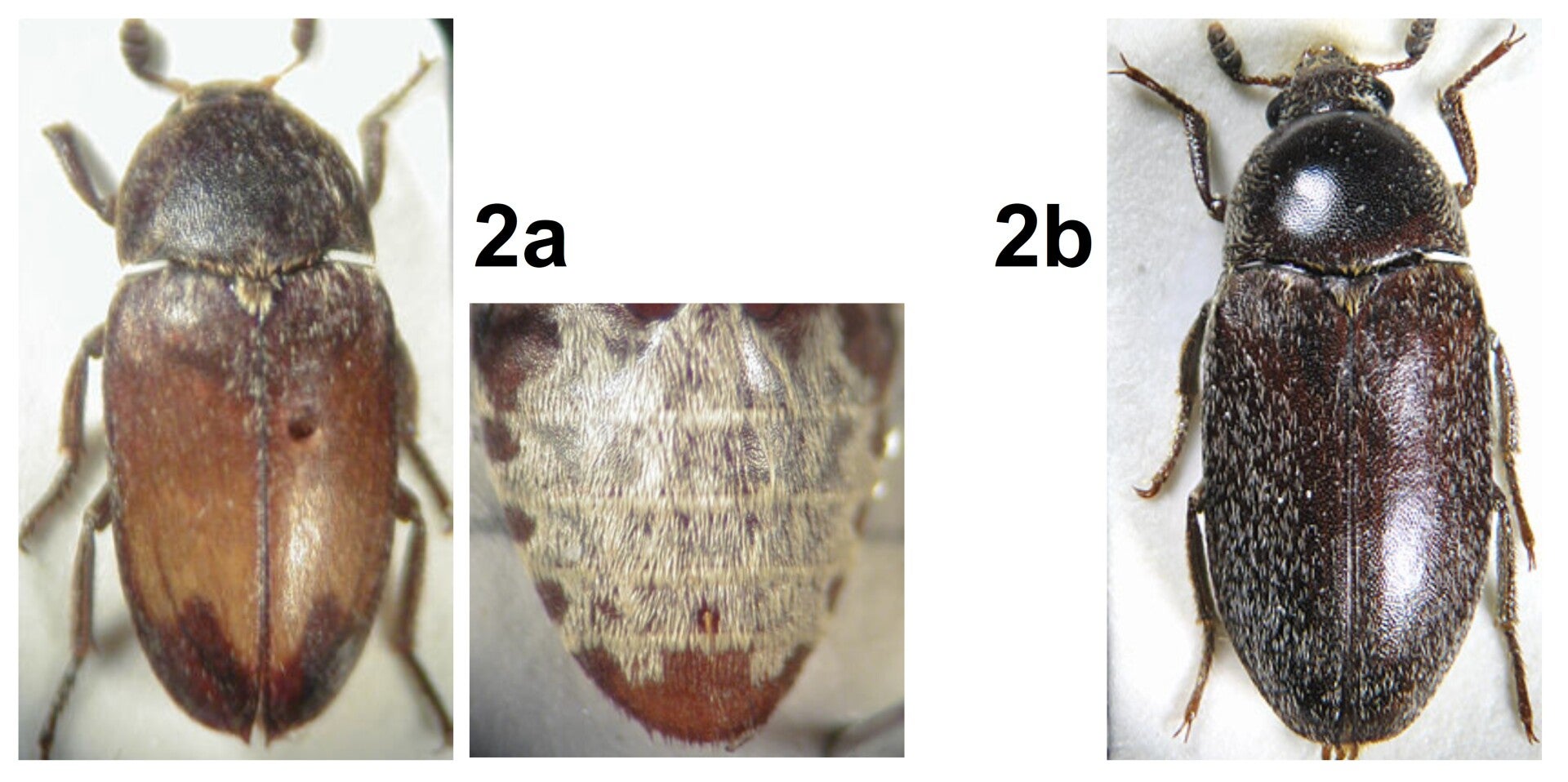
2a. Elytra bicolorous, orange/light brown with black apical spot.
→ Dermestes madagascariensis
2b. Elytra unicolorous black or brown. Go to question: 3
3a. Scutellum covered with brown-testaceous or yellowish hairs; nine or ten unevenly arranged spines besides the sutural angle; pattern on the last abdominal sternite; shape of male genitalia.
→ Dermestes maculatus
3b. Scutellum covered in white hairs; end margin of elytron with seventeen evenly distributed spines and a short strong spine at the sutural angle; pattern on the last abdominal sternite; shape of male genitalia.
→ Dermestes shaanxiensis
4a. The last abdominal sternite is covered with white hairs without a black spot at the apex of the sternite; shoulders of elytra contain patches of reddish hairs (sometimes almost black) and the rest of the elytra marmorate subtransversely with black and grey hairs; males have two tufts on the abdomen.
→ Dermestes carnivorus
4b. The last abdominal sternite is covered with white hairs with a black spot at the apex of the sternite; elytra do not contain patches of reddish hairs; males have one tuft on the abdomen. Go to question: 5
5a. White hairs are present above the black spot at the apex of the last abdominal sternite. Go to question: 6
6b. The black spot at the apex of the last abdominal sternite reaches to the top border of the sternite. Go to question: 7
6a. The white hairs on the pronotum are covered with white or light grey hairs, disc is covered with black hairs and some single white hairs, the posterior half of elytra contain black and white hairs.
→ Dermestes frischii
6b. The sides of the pronotum are covered with yellow hairs, disc with dark brown and yellow hairs, the posterior half of elytra contain black and yellow hairs with a small admixture of white hairs.
→ Dermestes planus
7a. The last abdominal sternite has two white spots of white hairs at the anterior margin; the lateral margins of the pronotum are arcuately emarginate in the posterior third.
→ Dermestes coarctatus
7b. The last abdominal sternite has two longitudinal stripes of white hairs; the lateral margins of the pronotum are rounded.
→ Dermestes sibiricus



Undescribed species?
The following beetle has been photographed in Macau, China. It is most likely a new undescribed species (Herrmann, pers. comm.), but without a photo of the ventral side or a collected specimen to study, nothing more can be said about this sighting with certainty.
A similar beetle was seen four years later in the same area.

Photo source: キース搵肥 on iNaturalist.org

Extra information:
The species Dermestes carnivorus has a variety named "doemmlingi" which occur in various populations of this species. This colour variation is characterized by the hairs on the pronotum being reduced to a light patch on each side, the hairs on its elytra are grayish-yellow and the shoulders are no longer light. The hairs on the abdomen, that are mainly white in the regular form, are now largely mixed with black hairs.
The two most common species of this species group to encounter worldwide are Dermestes maculatus and Dermestes frischii. These two species are easy to differentiate from each other by comparing the ventral pattern and with question 1 of the key guide above. But if these two traits are not visible, there is a third difference between the two: the pattern of the whit hairs on the lateral margins on the pronotum. The three key differences in short:
D. maculatus: (1. Black spot at the apex of the last abdominal sternite reaches the anterior margin of the sternite, shaped like an hourglass. (2. A spine is present at the end of each elytron. (3. The white hairs at the lateral margins of the pronotum are near the middle shaped like a spike pointing inwards.
D. frischii: (1. Black spot at the apex of the last abdominal sternite doesn't reached the anterior margin of the sternite, shaped like the top of a heart. (2. No spine is present at the end of each elytron. (3. The white hairs at the lateral margins of the pronotum are 'fringed' in shape, meaning two spikes are pointing inwards and bend posteriorly.

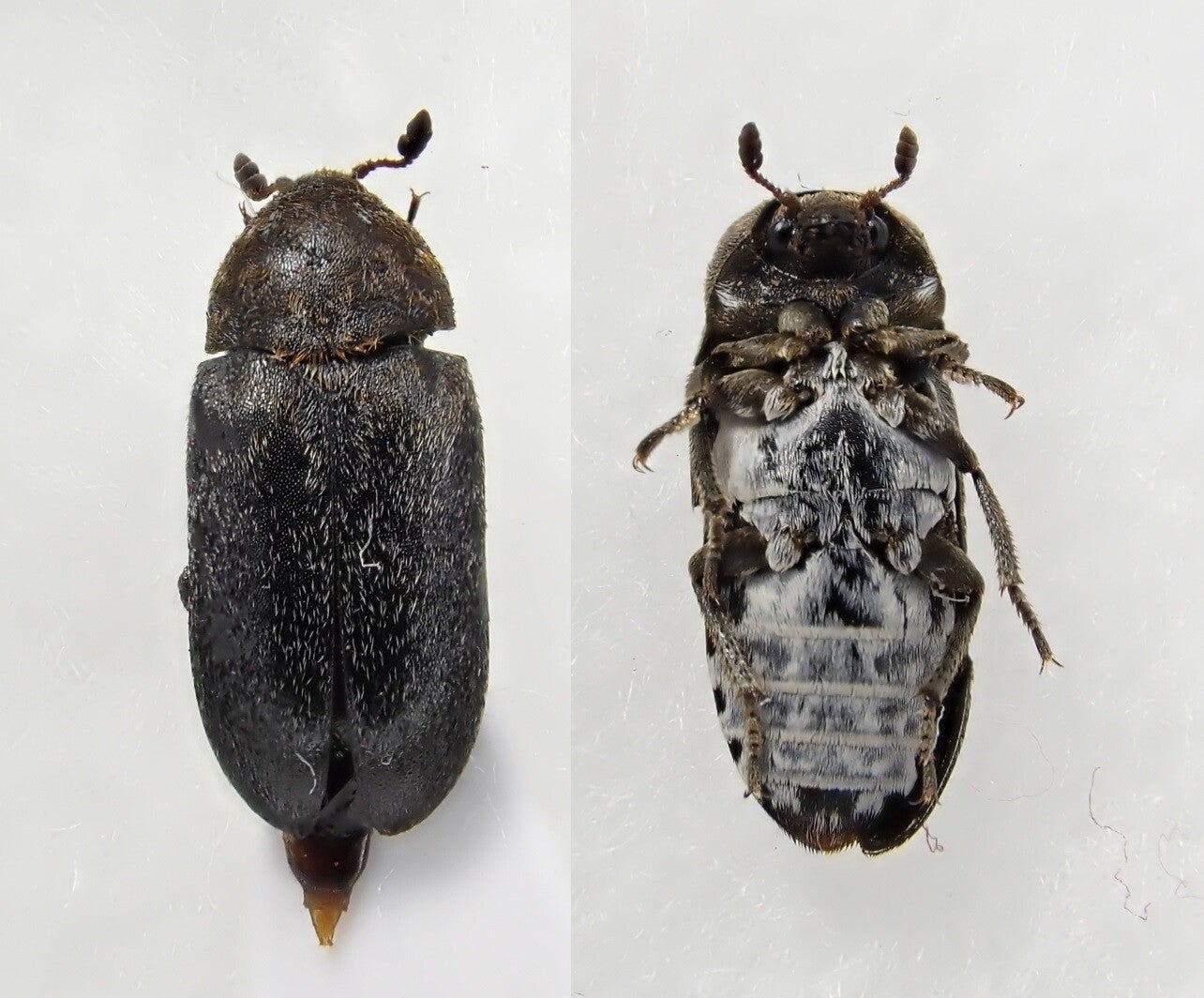
What is that on the left? It's quite an atypical specimen of Dermestes coarctatus from China. The pattern on the pronotum is not very recognizable anymore, so confusion with Dermestes tesselatocollis could occur. Luckily, the observer also took a photo of the beetle's ventral side. The pattern on the last abdominal sternite is a key to determine the species - however, this pattern is also quite atypical for this species. Inside the black spot at the apex, white hairs are present. The only other species of the maculatus species group with white hairs inside the black spot is Dermestes shaanxiensis, a fellow Chinese species.
Why this particular beetle deviates from it's regular form stays unclear, but it is something to keep an eye out for.
Made by Sarah Mahie
Created on: 30-12-2025
Latest update: 11-05-2026