

Species group: laniarius
These are the dichotomous keys to identify species of Dermestes (Coleoptera; Dermestidae) on a worldwide scale.
Click on the species names to go to their taxon page. Click here to go back to the subgenus page. Click here to go back to the main page.
1a. White hairs form a large transverse spot with serrated edges on pronotal disc.
→ Dermestes coronatus
1b. No big white spot on pronotal disc. Go to question: 2
2a. The pronotum, scutellum and elytra are quite densely covered by long golden yellow pubescence intermixed with white hairs.
→ Dermestes marocanus
2b. The pronotum and elytra are less densely covered in hairs and/or contain different colour hairs. Go to question: 3
3a. The pronotum is mainly covered with black hairs and some white hairs with a very distinct transverse band of yellow hairs in the center, similar in shape to { . Go to question: 4
3b. No transverse band of yellow hairs is present on the pronotum / if a transverse band of yellow hairs is present in the center, then it is surrounded surrounded by yellow hairs. Go to question: 5
4a. The last andominal sternite is black with two small semicircular spots of white hairs; the black spot behind the hind leg is completely bordered by white hairs; the white hairs on the elytra are scattered uniformly.
→ Dermestes sardous
4b. The last abdominal sternite is black with two enlarged and longitudinal spots of white hairs; the black spot behind the hind leg is accompanied by two smaller black spots, one connected and one completely separated; the white hairs on the elytra are scattered uniformly.
→ Dermestes asiaticus
4c. The last abdominal sternite is black with two elongated spots of white hairs, shortened anteriorly and usually also posteriorly; the white hairs on the elytra are in a mottled pattern.
→ Dermestes normandi
5a. Last abdominal sternite is almost entirely black (some white hairs may be present) and the posterior margin of the 4th abdominal sternite has two spots of black hairs. Go to question: 6
5b. No black spots at the posterior margin of the 4th abdominal sternite present / if two black spots are present at the posterior margin of the 4th abdominal sternite, then the last abdominal sternite is for the majority covered in light coloured hairs. Go to question: 8
6a. Majority of elytra and pronotum uniformly covered in black hairs mixed with whitish-grey hairs.
→ Dermestes laniarius
6b. The hairs on the elytra form a mottled pattern; brown hairs are present on the pronotum and elytra. Go to question: 7
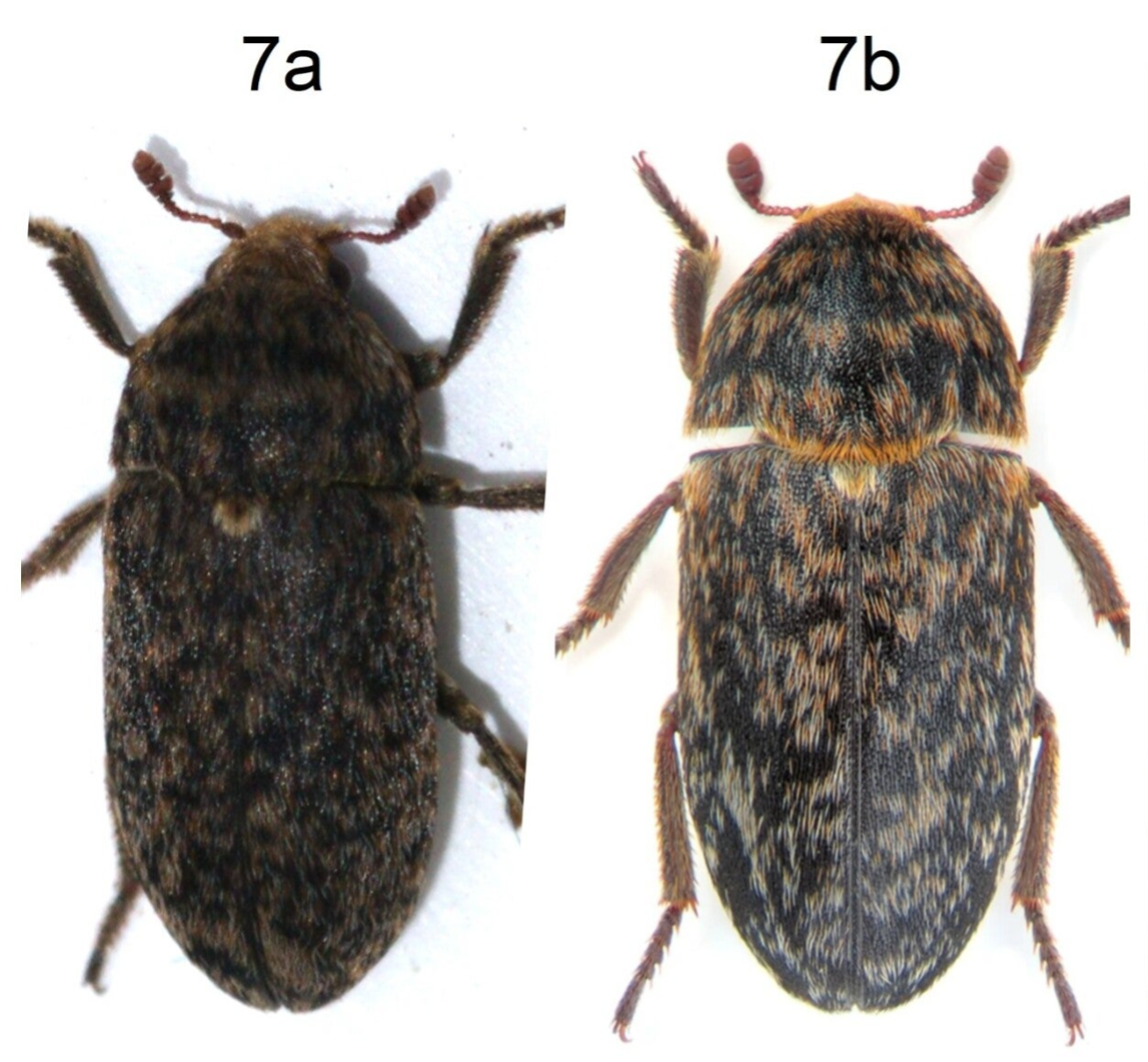
7a. Last abdominal sternite is almost completely black with two thin longitudinal stripes of lighter hairs (the anterior margin of the sternite, on the lateral sides of the adjecent black spots on the 4th abdominal sternite, is completely black); only white hairs presen on the trochanter of the hind legs; elytra with a mixture of yellow-red, yellow-white, gray-white or gray-yellow hairs, and sometimes yellow-red hairs largely replaced by gray-yellow hairs; base of the pronotum without clearly organized spots; upper surface of tarsi densely covered in white or yellow hairs; hind femora without a distinct band-like mark in the middle.
→ Dermestes mustelinus
7b. Last abdominal sternite is slmost completely black with a thin stripe of lighter hairs at the anterior margin of the sternite (these white hairs can start to form two longitudinal stripes on the lateral sides of the adjecent black spots on the 4th abdominal sternite); dark hairs present on the inner side of the trochanter; elytra marbled with black hairs and gray-yellow or gray-white hairs, the gray-white hairs predominate in posterior half and sometimes yellow hairs entirely replaced; base of the pronotum with distinct spots enclosed by small black areas; upper surface of tarsi almost glabrous; hind femora with a distinct band-like mark of white hairs in the middle.
→ Dermestes kaszabi
8a. Last abdominal sternite is almost fully covered with light coloured hairs, except for two black spots at the lateral margins and a small black spot at the apex of the sternite; the majority of the abdomen are covered in light orange brown hairs; the elytra are covered in black and grey whitish hairs; scutellum fully and overall densely covered in yellow hairs.
→ Dermestes erichsoni
8b. Black spot at the apex of the last abdominal sternite reaches the anterior margin; the elytra also contain yellow / brown hairs. Go to question: 9
9a. The last abdominal sternite is black with two spots of lighter coloured hairs at the anterior margin; the majority of the abdomen are covered in light brown hairs; the pronotum and elytra are covered in brass-yellow hairs with some mottled black spots.
→ Dermestes aurichalceus
9b. The last abdominal sternite contains two longitudinal stripes of white hairs that reach the posterior margin; the majority of the abdomen are covered in white hairs. Go to question: 10
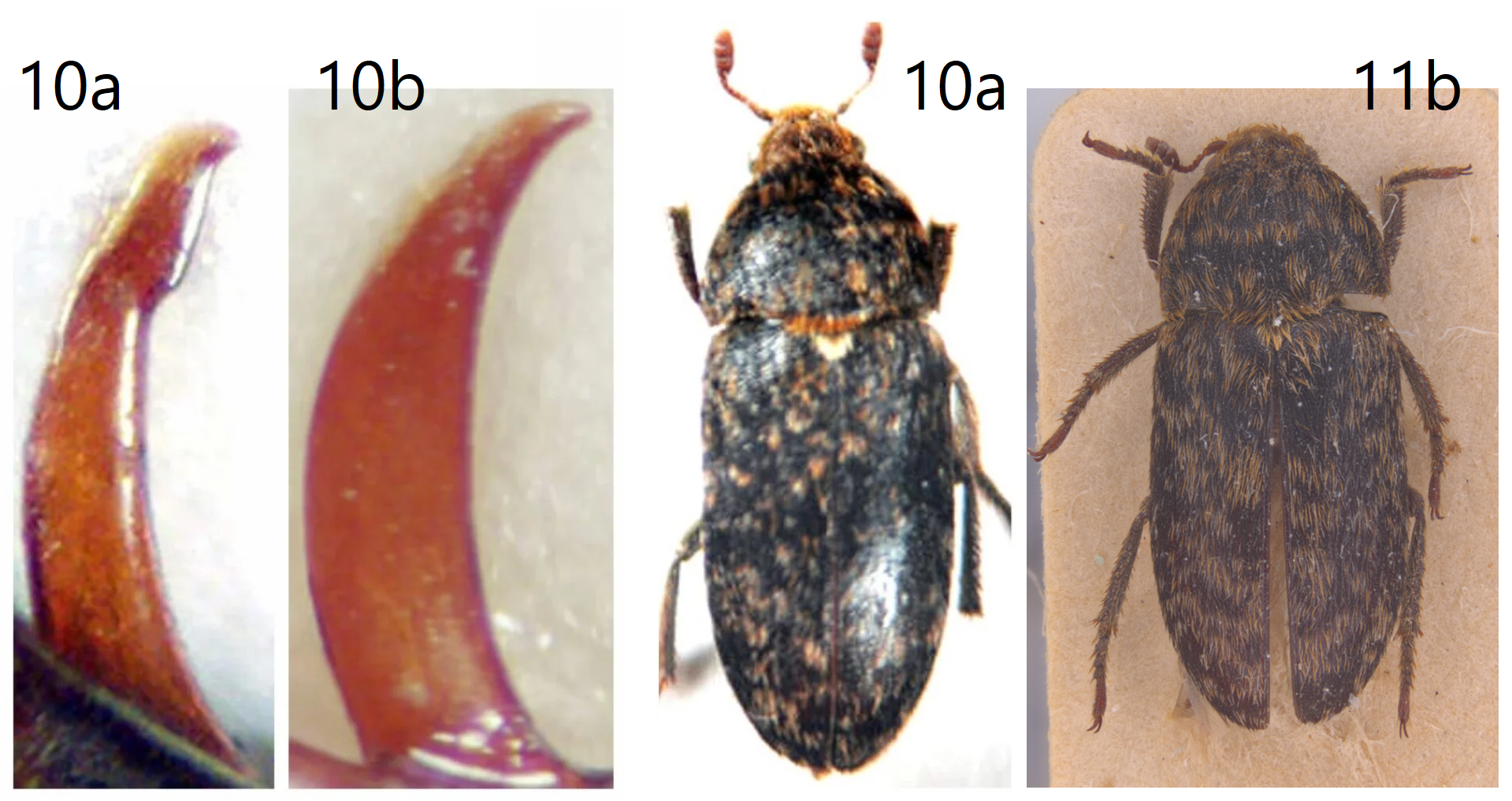
10a. Shape of male genitalia; the pronotum and elytra are covered in brown and black hairs in a marbled pattern; body narrower than 3.15 mm, body more than 2.5 times long as width (length: 6.4-8.1 mm, width: 2.5-3.1 mm).
→ Dermestes loebli
10b. Shape of male genitalia. Go to question: 11
11a. The first abdominal sternite appears to have a small black spot connected posteriorly with the big black spot located directly behind each hind leg; shape of the male genitalia: regulary rounded all along its length; elytra with grayish-white and yellowish-red hairs, the reddish-yellow hairs more abundant on basal half and sparse on apical half; base of the pronotum with distinct spots enclosed by small black areas; length: 6,5-8mm, body wider than 3.15 mm.
→ Dermestes intermedius ssp. intermedius
11b. The first abdominal sternite has a black spot located directly behind each hind leg with only white hairs present posteriorly; shape of the male genitalia: slightly vaulted with small point on inner side of the apical third as; elytra covered in black and brown hairs mixed with sparse pale hairs, brown spots at the base of the pronotum not totally enclosed by black areas; narrow body, body less than 2.5 long as width (length: 6-6.7 mm, width: 2.7-3.2 mm).
→ Dermestes intermedius ssp. iranicus








Extra information:
The species Dermestes laniarius has a colour variant named "subfulvicollis". The black hairs the nominal species has are completely absent in this colour variation. The head, pronotum and scutellum are covered with a mix of yellowish-red and yellowish-white hairs. The elytra are covered less densely, but with the same colour hairs. It has been found in Kazakhstan and Russia.
The species Dermestes sardous has a colour variant named "striatellus" and this variation is characterized by brown longitudinal dorsal stripes along their elytra. It has been found in Egypt and in California, USA, where the species is introduced.

Click here for more "subfulvicollis" examples.

Click here for more "striatellus" examples.
Made by Sarah Mahie
Created on: 30-12-2025
Latest update: 05-07-2026