

Species group: marmoratus
These are the dichotomous keys to identify species of Dermestes (Coleoptera; Dermestidae) on a worldwide scale.
Click on the species names to go to their taxon page. Click here to go back to the subgenus page. Click here to go back to the main page.
1a. Elytra without distinctive subbasal band, but whitish hairs forming band or patches extending to base of pronotum; three white spots are present on the pronotum, they are not completely circular in shape and sometimes blend in with surrounding white hairs; the last abdominal sternite contains two patches of white hairs at the posterior edge.
→ Dermestes caninus
1b. Elytra with subbasal band of whitish hairs; the last abdominal sternite doesn't contain white hairs at the posterior edge. Go to question: 2
2a. Lower half of elytra covered with small intermingled patches of brown, whitish, and black hairs; three circular white spots are present on the pronotum; body longer than 8 mm; two spots of white hairs are present at the anterior edge of the last abdominal sternite.
→ Dermestes marmoratus
2b. Lower half of elytra covered with small intermingled patches of whitish and black hairs; no distinctive white spots are present on the pronotum; body shorter than 8 mm; three spots of white hairs are present at the anterior edge of the last abdominal sternite.
→ Dermestes fasciatus
Extra information:
Dermestes caninus has two colour morphs: 1. "caninus": in this case less than half of the elytra are covered in whitish hairs (the left picture of key 1a); and 2. "mannerheimi": in this case the elytra are more than half of the elytra are covered in whitish hairs (the right picture of key 1a).


Beal (1994) spoke about the D. caninus-rattus complex. Just like Dermestes caninus and Dermestes marmoratus, the fellow American species Dermestes rattus (currently categorized in the murinus species group) also has three small white spots of white hair on the pronotum. The three white spots of D. rattus looks most similar to D. marmoratus, since both species these spots are very circular. This species has two colour morphs: 1. "rattus": elytron covered with nearly all white hairs with small, irregular patches of black or dark brown hairs; and 2. "tristis": elytron covered with all black or dark brown hairs or all dark hairs except for few intermingled white or golden white hairs. The second colour morph can dorsally look very similar to the "mannerheimi" colour morph of Dermestes caninus.
Dermestes rattus rattus can be differentiated from Dermestes caninus mannerheimi by the following two keys:
1. Hairs on the posterior half of the elytra:
D. caninus mannerheimi: patches of lighter and darker hairs.
D. rattus rattus: mainly light hairs.
2. Hairs on the abdomen:
D. caninus mannerheimi: mainly covered in white hairs.
D. rattus rattus: mainly covered in brown hairs with a big white spot in the anterior middle.
Dermestes rattus rattus:


Interestingly enough, the larva of D. rattus deviates from other species of the murinus species group by having a small oblong non-pigmented area containing a dark pigment spot laterally on each side of the pronotum. It shares this particular trait with the larva of D. caninus.
Photo gallery:
Dermestes caninus:

Dermestes marmoratus:

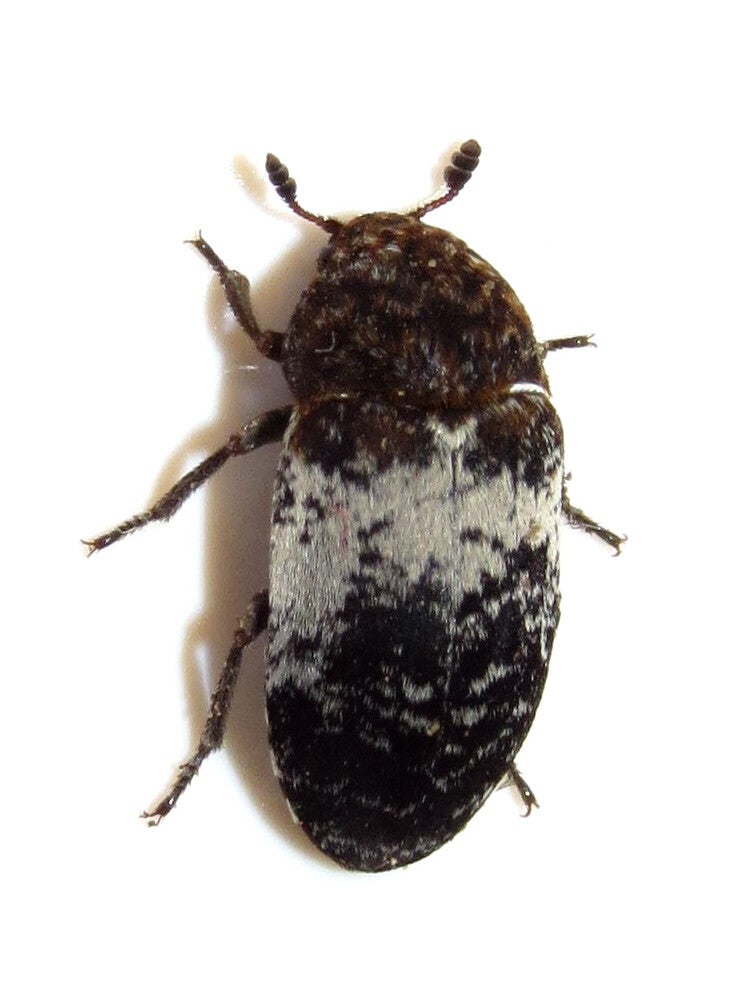
Dermestes fasciatus:
Made by Sarah Mahie
Created on: 30-12-2025
Latest update: 08-03-2026