

Frequently Asked Questions
Do dermestid beetles eat feathers and fur?
The Dermestidae family can be split into two groups: nidicoles (such as Anthrenus) and necrobionts (such as Dermestes). The nidicolous beetles feed on keratinous materials, such as feathers and fur. The necrobionts consume only soft tissues of the dead bodies. The whole biology of these two groups differ from each other due to their different diet. The larvae of Anthrenus can starve for a very long time (years) and the adult beetles are short-lived and feed on nectar or pollen to supplement for the lack of nutrition caused by a keratin diet. The larvae of Dermestes are not adapted to prolonged starvation due to their high metabolism and develop relatively fast (1-2 months, no longer than 4 months) and the adults are long-lived. Feathers and fur have a water content of less than 10-12%, but the larvae of Dermestes can only succesfully develop on food containing no less than 15% water. So no, Dermestes will not eat feathers or fur. If someone talks about dermestid beetles eating taxidermy, then they are referring to a nidicole species such as Anthrenus museorum, whom gained its Latin name from the damage it causes to museum specimens. It is highly recommended to skin the animals that you would like to skeletonize, otherwise you will be left with feathers or fur scattered throughout the whole of your beetle enclosure.
I think my larvae died. What is going on?
If circumstances suddenly become less ideal for the larvae, for example during transportation, this can trigger pupation. Pupae are the same colour as the wood chips inside the container, so they are easy to miss upon arrival of the container. Before pupation, the larvae become stiff and motionless. It is important to leave those larvae alone and don't pick them up or squeeze them, since the pupation process is very delicate and they can die if you harm them in this state. In a few days, you will notice that the stiff larva molted into a pupa. Dead larvae turn black and shriffle up, except when the larvae are recently killed by insecticide. If the larvae are exposed to pesticide, their whole body balloons, restricting any motion. If this happens, the exposed adult beetles will relentlessly move their legs before they die of exhaustion.
How do I clean my dermestid beetle enclosure?
The beetles themselves and their frass do not smell. If you exclusively give your beetles non-stinky food, such as lung cubes, then no smell will develop. If you clean skeletons with your beetles, then it is highly recommended to minimize the carcass smell:
(1. Skin and gut the animal, with emphasis on removing the abdominal organs.
(2. Dry the meat-enveloped bones so the tissue won't start to rot.
(3. Use a 'diner plate' to prevent the carcass from contaminating the substrate. For example a cardboard tray that can be thrown away after use or a plastic tray that can be cleaned after use.
The last step is very important. If you keep the substrate as clean as possible, then you can keep it in the enclosure for a very long time without the need to refresh it. During this time, only 'small cleanings' can be sufficient. Larvae sheds consist of chitin, a material that will not rot and is in no way harmful to the beetles, so this can be left in the substrate. Someone once told me that "the beetles make their own substrate" with their sheddings. How to clean the enclosure from build-up frass (a small cleaning):
(1. Grab a handfull of substrate and beetles and put them in a sieve.
(2. Sieve out all the frass; this goes into a seperate container.
(3. Put the sieved out substrate and beetles into a new enclosure and repeat until the old enclosure is empty.
(4. Very small larvae might fall through the sieve and end up in the frass container. In case you don't want to throw those larvae away, you might want to postpone discarting the frass. Give the small larvae something to eat and they eventually will grow to a size where you can sieve the frass for a second time without them falling through.
If the substrate became dirty and needs to be renewed, prepare for a 'big cleaning' that ain't as easy and will result in the loss of some beetles. Hence why, prevention is better than cure. What I currently ought to be the best method is to let the beetles walk out of the substrate themselves. How to refresh the substrate (a big cleaning):
(1. Build a set-up to catch the beetles that crawled out of the substrate, so they can't return. I use a pyramid with a hole at the top and surround the pyramid with the dirty substrate. The beetles will climb the pyramid and will fall through the hole into a seperate container. Put some food in the collection container to lure the beetles more effectively.
(2. The longer this set-up stays, the more beetles you will seperate from the old substrate. For example, some pupae might need some time to hatch first.
(3. Put the collected beetles into a new enclosure with fresh substrate.
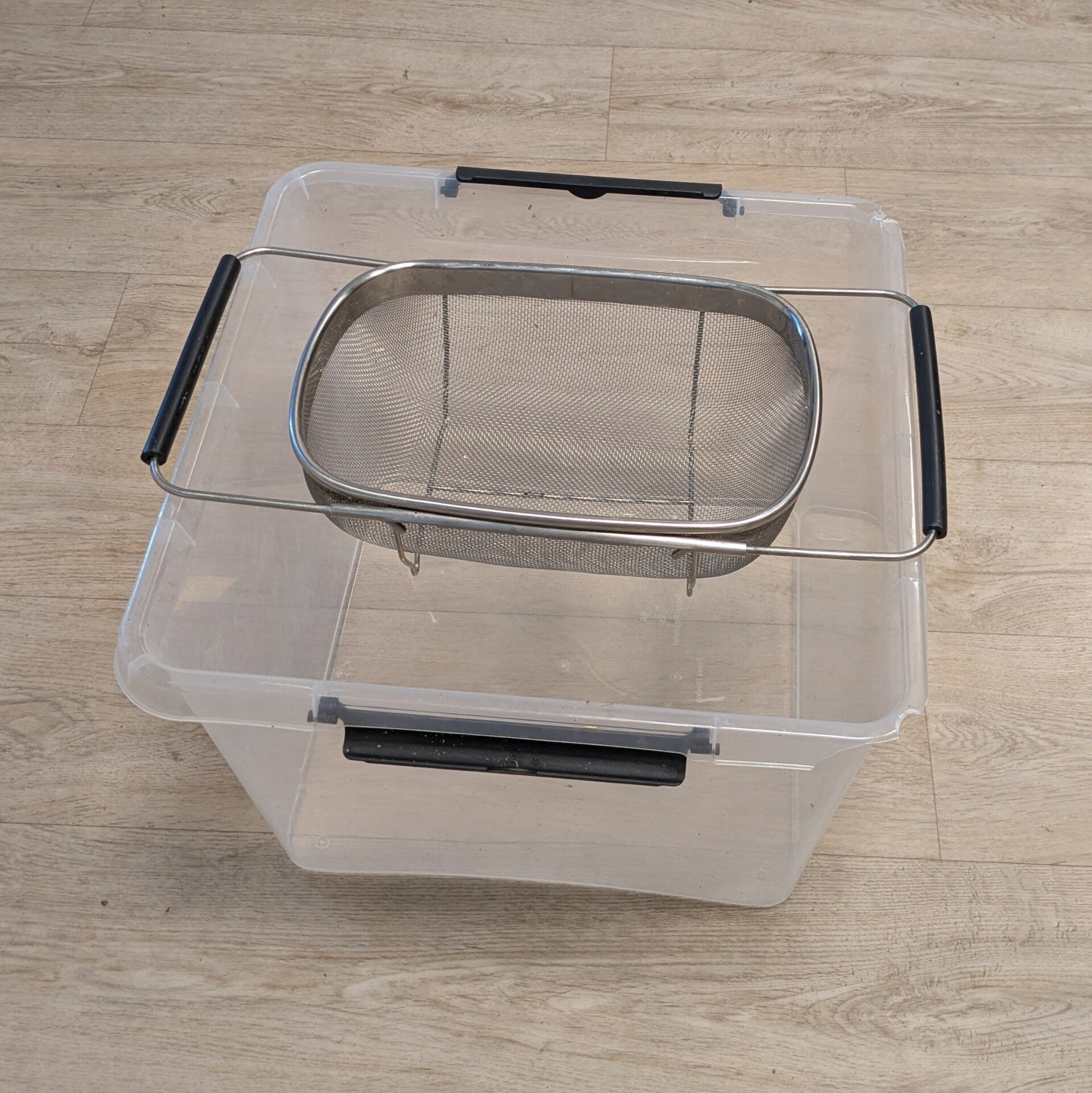
Image above: Set-up for a small cleaning.
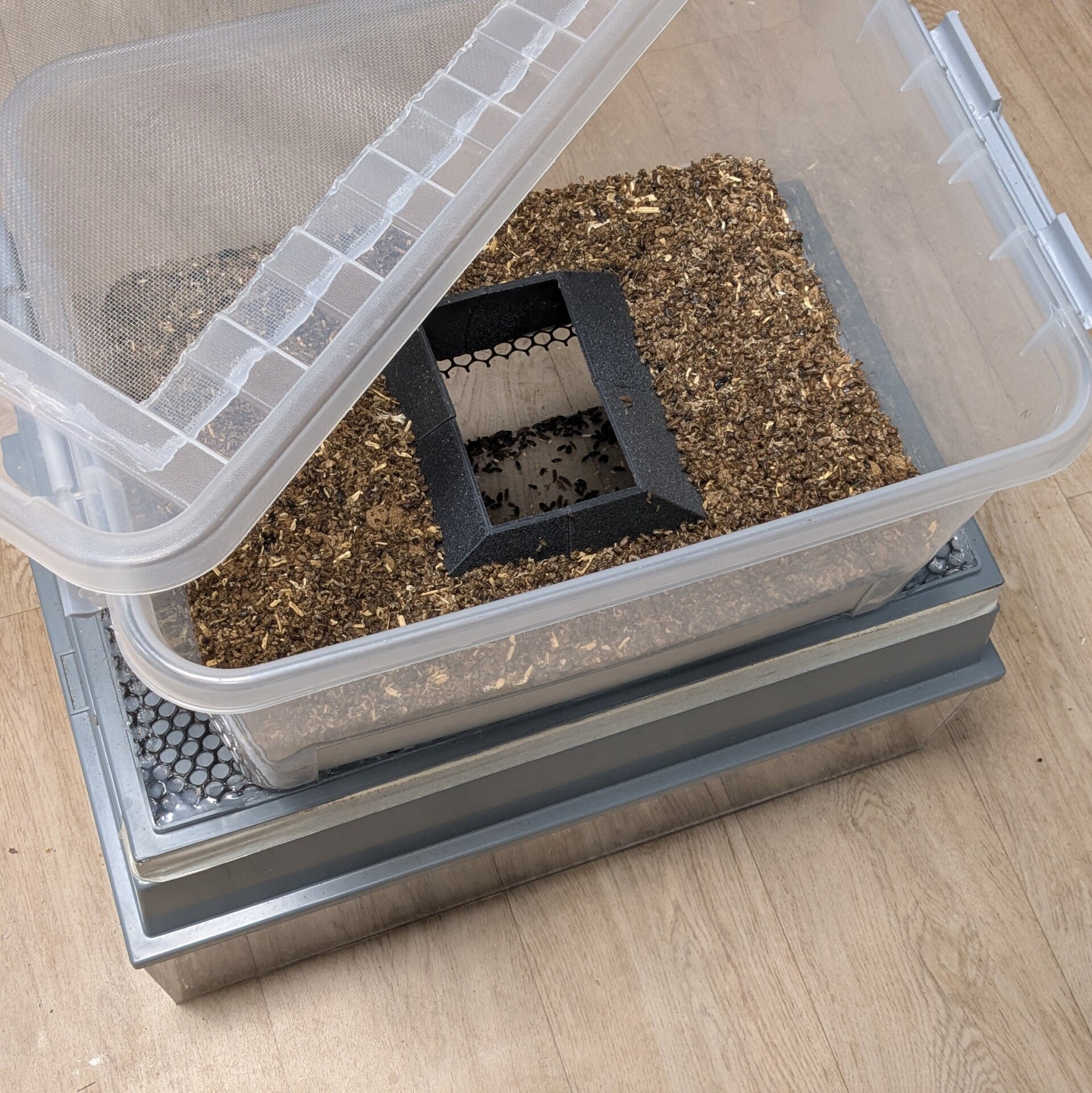
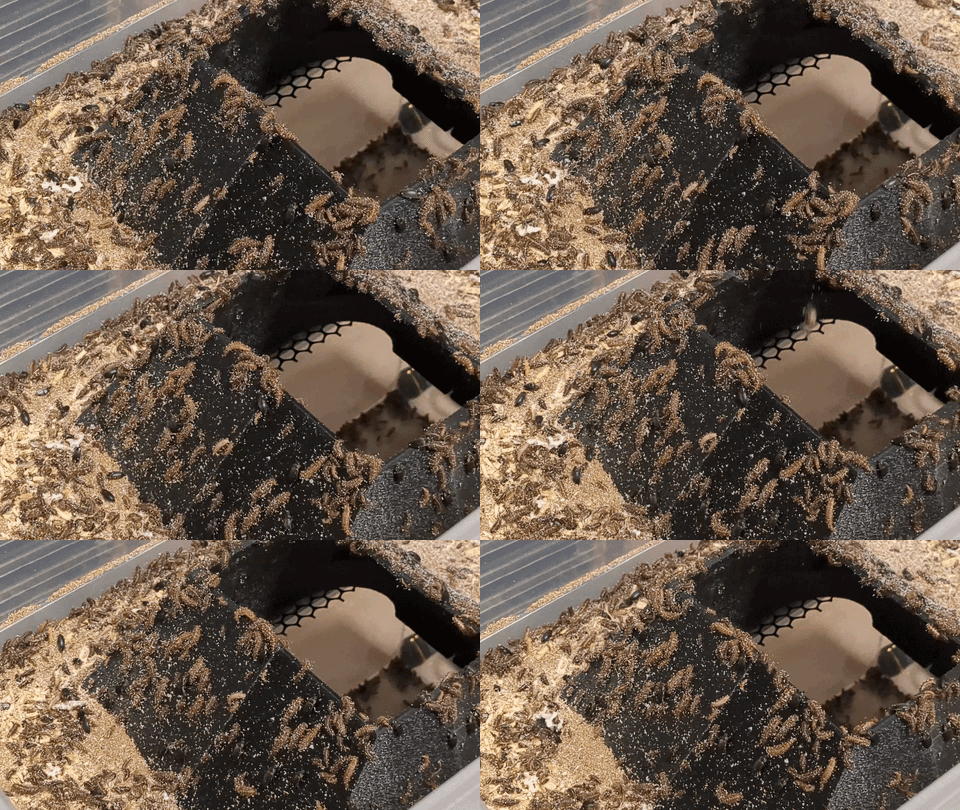
Image aboves: Set-up for a big cleaning.
Do I need to keep my beetles in the dark?
No, this is a myth. There is no difference in the speed in which the beetles will clean skeletons in a dark or light setting. In nature, a sudden change in light intensity might mean that a predator is nearby, so this will startle the beetles. If the beetles are used to light, a sudden shadow might scare them, because this could be the shadow of a bird. If the beetles are used to the dark, sudden light might scare them, because this could mean that their save home is ripped apart by something big. The adults of the subgenus Dermestinus are actually more active during the day. If you keep these species in transparant enclosures, you might notice that they can get less active in the evening and night.
Can I use a heating mat to keep my beetles warm?
I strongly discourage the use of heating mats. In nature, heat comes from above: directly from the sun or from the surrounding air. It is not uncommon for the larvae to dig themselves into the substrate to pupate. If heat builds up in the substrate, it can harm the pupae whom do not have the ability to escape. Besides, if you keep the beetles in a plastic enclosure, the build-up of heat underneath the substrate also poses a big threat of melting the plastic (that happened to me in my early days of keeping dermestid beetles). Adult beetles enjoy climbing to the highest point, where the warmth of a mat won't reach. In case it is not possible to house the beetles in a room that is at least room temperature or if you want to provide some extra warmth to boost the beetles their productivity, a heat lamp is a much better alternative.
Can I put a mix of different Dermestes species in my enclosure?
Different Dermestes species also co-occur in nature and sometimes multiple species can be found sharing a food source. The beetles won't harm other species and all species can be mixed. However, note that some species prefer slightly different environmental conditions than others. Read more about the preferred conditions for each species on The available species page. Another important trait to keep in mind is the reproductive rate. Dermestes maculatus quickly grows in numbers, whereas species like D. murinus and D. lardarius multiply much slower. If slower breeding species are kept together with D. maculatus, then it is almost guaranteed that you will end up with D. maculatus being the dominant species in the enclosure. The other species will become a sporadic sighting.
How many beetles do I need to cleans skulls and/or skeletons?
Read more about this on the How to beetle-clean bones page.
Sources:
- Zhantiev R. 2009: Ecology and classification of dermestid beetles (Coleoptera, Dermestidae) of the Palaearctic fauna. Entomological Review 89(2): 157-174. DOI