

Subgenus: Dermestinus
These are the dichotomous keys to identify larvae of the genus Dermestes (Coleoptera; Dermestidae) on a worldwide scale.
Click here to go back to the main page.
1.1.a. Pronotum without a small oblong non-pigmented area containing a dark pigment spot and urogomphi are pointed upwards and forward or nearly straight. Go to question: 1.2
1.1.b. Pronotum laterally on each side with a small oblong non-pigmented area containing a dark pigment spot. / If no such spot is present, then the urogomphi are directed backwardly and curved downwards. Go to question: 20
1.2.a. Frons without two tubercles at anterior margin. Go to question: 2
1.2.b. Fons with two tubercles at anterior margin. (Group: necrobionts) Go to question: 8
2a. Well developed urogomphi, roughly as long as the diameter of segment 9 at the posterior margin. (Group: necrobionts/herpetobionts intermediate; species group: gyllenhalii) Go to question: 3
2b. Shortened urogomphi. (Group: herpetobionts; species group: laniarius) Go to question: 4
3a. Head light rufous, prothoracic tergite brownish rufous with two brownish Z-shaped spots, the rest of the tergites dark brownish.
→ Dermestes szekessyi
3b. Head and all tergites brownish, prothoracic tergite with light longitudinal stripe interrupted in the middle.
→ Dermestes gyllenhalii
4a. Urogomphi very short, inconspicuous. Body densely covered with long yellow setae, tergites with contrasting brownish or black pattern. Prothoracic tergite with a light dorsal stripe that is interrupted in the middle by a dark spot and two small lighter spots on each side beside the dorsal stripe. Sometimes the brown areas on the prothoracic tergite are reduced to spots forming the shape of a circle on each side.
→ Dermestes laniarius
4b. Urogomphi large or medium-sized, at least half as long as the diameter of segment 9 at the posterior margin. Go to question: 5
5a. Head yellow, with rounded brown spot in the fronto-vertical area. Urogomphi bent forward, about half as long as the diameter of segment 9 at the posterior margin. Prothoracic tergite brown, with light longitudinal stripe.
→ Dermestes erichsoni
5b. Head without rounded brown spot in fronto-vertical area. Urogomphi less bent. Go to question: 6
6a. Older instar larva without light longitudinal stripes on head. Body dorsally with a wide, median, yellowish stripe. Prothoracic tergite is brownish yellow, with two large dark brown spots. Urogomphi slender, straight, pointed posteriad, half as long as the diameter of segment 9 at the posterior margin.
→ Dermestes coronatus
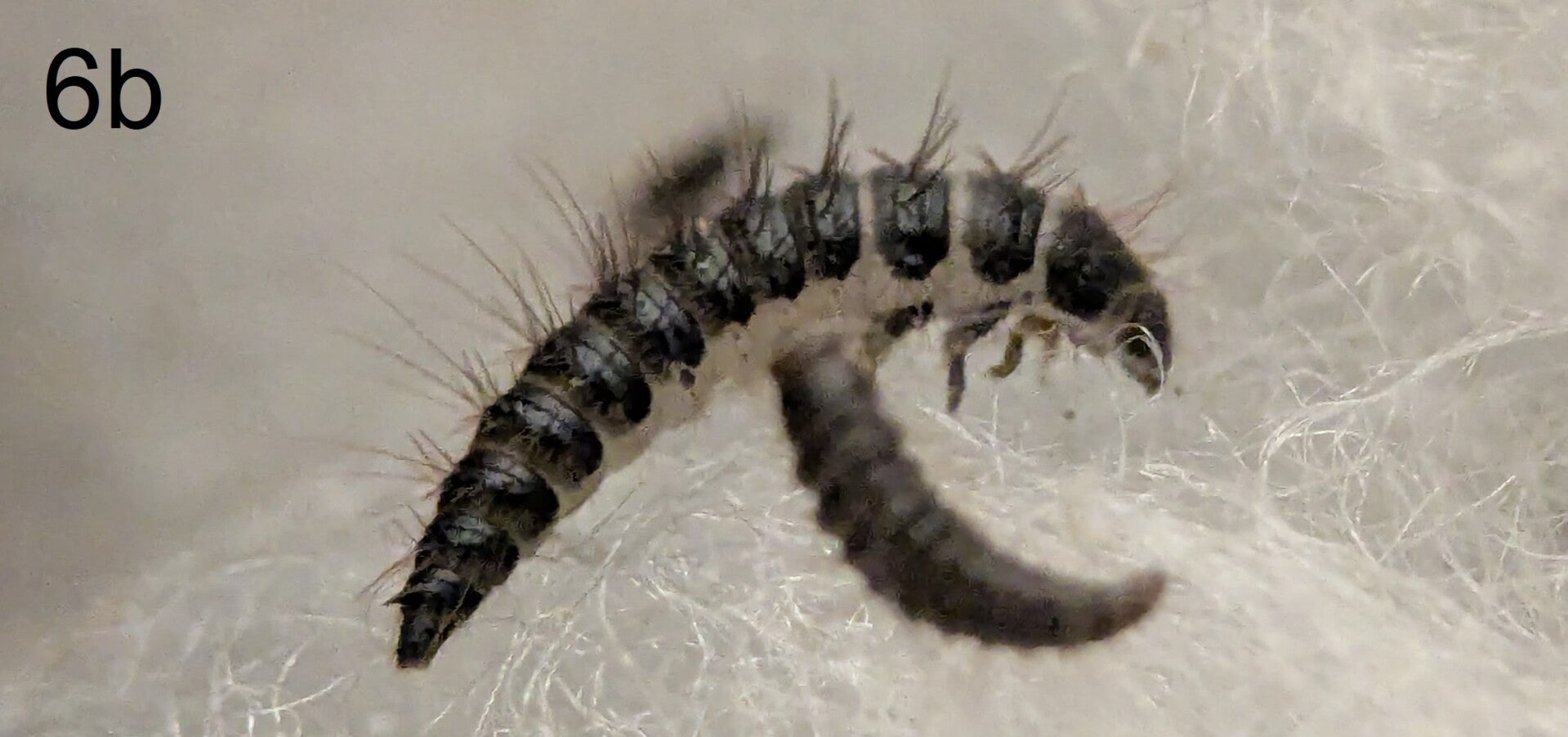
6b. Older instar larva without light longitudinal stripes on head. Body overall very dark in colour, with a light, beaded, median stripe on the thoracic tergites. Posterior satae very short. Urogomphi conical.
→ Dermestes aurichalceus
6c. Older instar larva with two light longitudinal stripes on head. Go to question: 7
7a. Dorsal body surface with wide beaded light longitudinal stripe. Prothoracic tergite brownish yellow, with two dark brown spots shaped similar to " > < " as seen from above. Urogomphi conical, about 0.33 times as long as the diameter of segment 9 at the posterior margin.
→ Dermestes kaszabi
7b. Prothoracic tergite with light lateral areas along the dorsal stripe. Abdominal tergites 4 to 9 with a transverse row of about 12 retrorse tubercles behind the anterocostal suture. Urogomphi straight.
→ Dermestes mustelinus
7c. Prothoracic tergite brownish yellow, with two dark brown spots shaped similar to " • • " as seen from above. Body is yellowish with greyish / brownish areas on the abdominal tergites. Posterior satae very long. Urogomphi conical.
→ Dermestes sardous
7d. More data is needed. Body dorsally with a light, broad, median stripe on on the intersegmental membranes of tergites. Prothoracic tergite brownish yellow with a transverse dark stripe, somewhatshaped like a bow: wide at the lateral margins and narrow around the midle.
→ Dermestes intermedius
8a. Prothoracic tergite without light longitudinal stripe. (Species group: murinus) Go to question: 9
8b. Prothoracic tergite with longitudinal stripe, complete or interrupted in the middle. Go to question: 11
9a. Urogomphi large, strongly bent forward, only slightly shorter than the diameter of segment 9 at the posterior margin. Abdominal spiracles lying at the apices of stringly protruding conical cuticular outgrowths.
→ Dermestes tessellatocollis
9b. Urogomphi weakly bent forward, 0.58-0.62 times as long ast the diameter of segment 9 at the posterior margin. Abdominal spiracles slightly protruding over cuticle surface. Go to question: 10
10a. The tip of the urogomphus is directly above the posterior border of the base as seen from aside. Urogomphi are 0.62 times as long as the diameter of degment 9 at the posterior margin. Body dorsally with a short stripe extending from the posterior margin of the prothorax to the abdominal tergite 2 and occasionally noticeble only on intersegmental membranes. Retrose tubercles on abdominal tergites covered with fine outgrowths, more abundant near the apex.
→ Dermestes undulatus
10b. The tip of the urogomphus is behind the posterior border of the base as seen from aside. Urogomphi are 0.62 times as long as segment 9 at the posterior margin. Dorsal body surface with longitudinal row of light spots on the intersegmental membranes of thoracic segments and the basal abdominal segments 5 to 7. Apices of the retrose tubercles star-shaped.
→ Dermestes murinus
10c. The tip of the urogomphus is behind the posterior border of the base as seen from aside. Body dorsally with broad, median, yellowish stripe extending posteriorly from anterior margin of mesonotum. The tubercles on the frons are prominent. An anterior transverse series of fully developed retrorse tubercles on abdominal tergites 4 to 9, tubercles terminally with short acute processes and terminal seta.
→ Dermestes talpinus
11a. Urogomphi bent forward. (Species group: maculatus) Go to question: 12
11b. Urogomphi more or less straight. Go to question: 17
12a. Abdominal tergites without retrose tubercles. Go to question: 13
12b. Abdominal tergites 4 to 9 with a transverse row of short retrose tubercles. Go to question: 14
13a. Posterior side of tibiotarsus without additional apical seta. Posterior margins of tergites with setae varying from rather thick to very fine. Urogomphi nearly half as long as the diameter of segment 9 at the posterior margin.
→ Dermestes planus
13b. Posterior side of tibiotarsus without additional apical seta. Posterior margins of tergites covered with setae of subequal thickness. Urogomphi no less than 0.67 times as long as the diameter of segment 9 at the posterior margin.
→ Dermestes sibiricus
14a. Dorsal body surface with light longitudinal stripe that is interrupted in the middle on the prothoracic tergite. Go to question: 15
14b. Dorsal body surface with wide longitudinal stripe, not interrupted on the prothoracic ternite. Go to question: 16
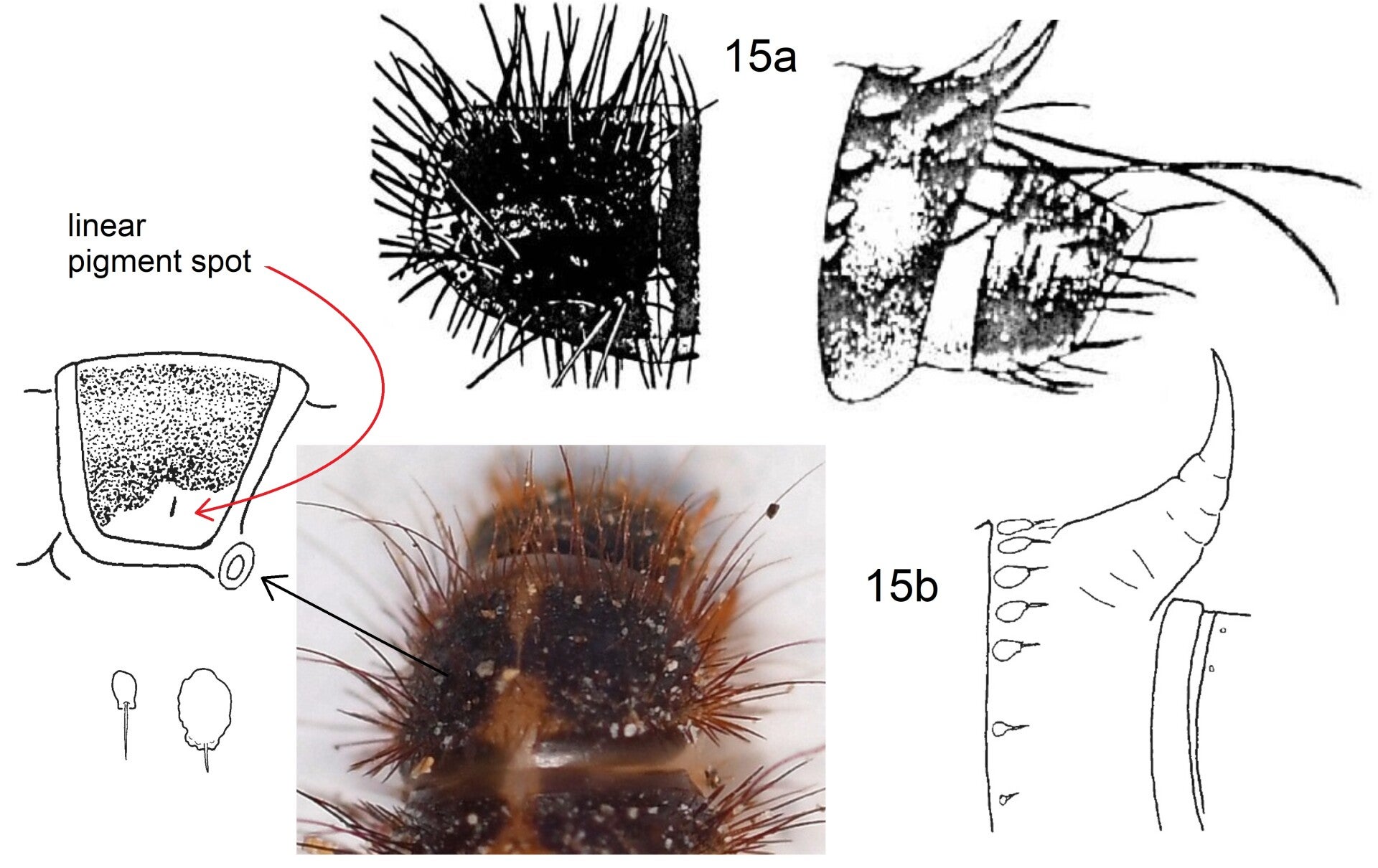
15a. Spiracles incorporated into tergites beginning from abdominal segment 3. Tergites 4 to 9 with a row of short retrose tubercles covered with outgrowths behind the antecostal suture. Urogomphi 0.77 times as long as the diameter of segment 9 at the posterior margin.
→ Dermestes coarctatus
15b. Unpigmented area at sides of pronotum with an insignificant linear pigment spot. Usually 3 anterior abdominal spiracles free (not attached to sclerotized pigmented area of tergite). Retrorse tubercles very small and insignificant on abdominal tergite 4 (smaller than those on tergite 9), becoming progressively larger posteriorly, reaching maximum development on abdominal tergite 8. Urogomphi longer and more curved than in D. coarctatus.
→ Dermestes frischii
16a. Sides of pronotum with a large unpigmented area containing one or two oval pigment spots. Usually 2 anterior abdominal spiracles free (surrounded by a small unpigmented area). Retrorse tubercles apically rounded, with acute wart-like processes. Ocelli large, ventral pair nearly as close together as dorsal. Urogomphi bent forward, 0.71 times as long as the diameter of segment 9 at the posterior margin.
→ Dermestes maculatus
16b. Sides of pronotum with only a narrow unpigmented area along lateral margin and with a pigment spot in an oblong unpigmented area enclosed in the pigmented area. Usually only 1 abdominal spiracle free, others joined to pigmented areas. Retrorse tubercles bilobed apically, each lobe with acute processes. Ocelli smaller, ventral pair more widely spaced.
→ Dermestes carnivorus
17a. Light longitudinal stripe on prothoracic tergite is interrupted in the middle along 1/3th of its length or more. (Species group: elegans) Go to question: 18
17b. Light longitudinal stripe on prothoracic tergite narrowing in the middle or interrupted along less than 1/3th of its length. (Species group: dimidiatus) Go to question: 19
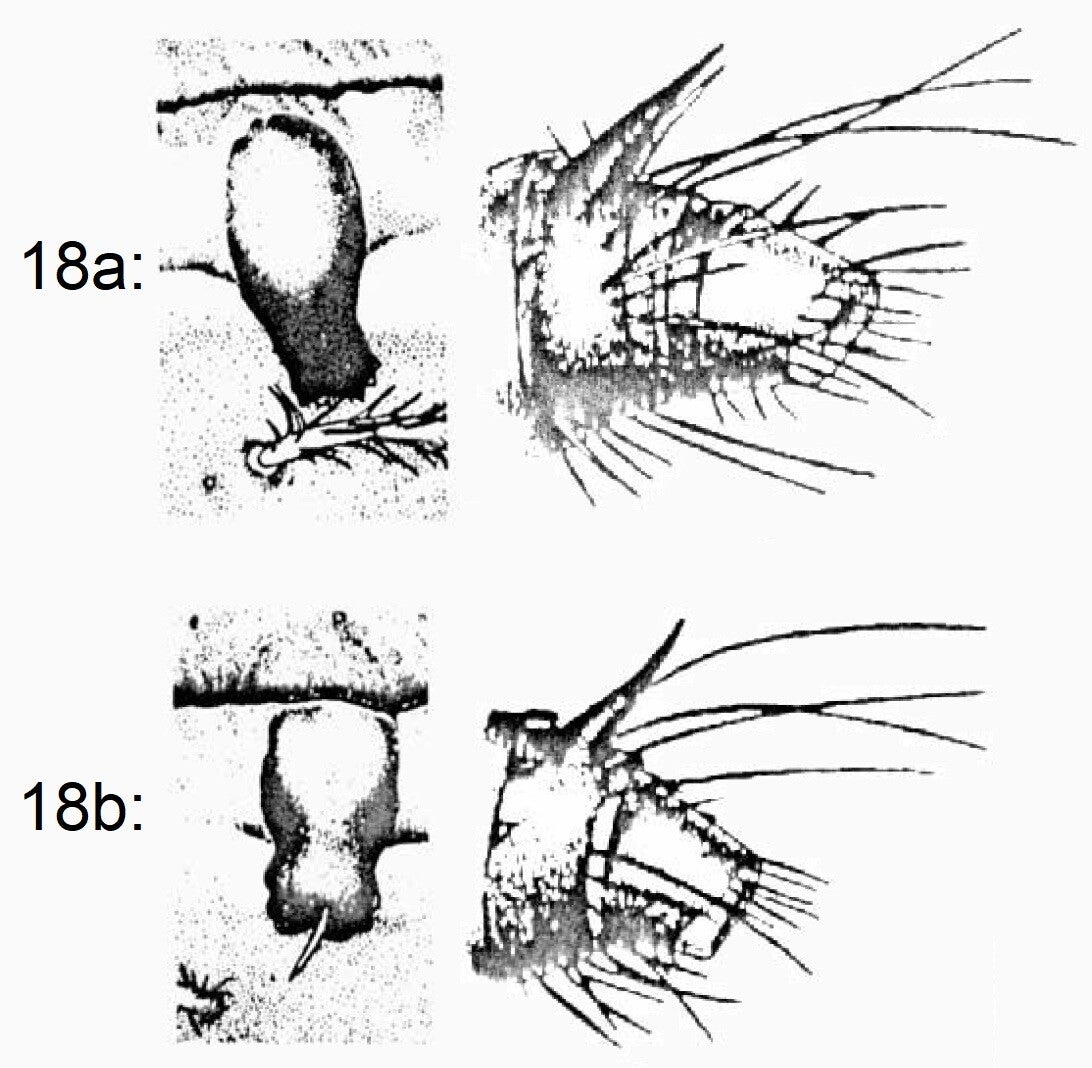
18a. Retrose tubercles on abdominal tergites sharply pointed to apex bearing small conical outgrowths. Urogomphi somewhat swollen in basal half and noticebly narrowing after midle, 0.67 times as long as segment 9 at the posterior margin.
→ Dermestes elegans
18b. Retrose tubercles on abdominal tergites widened to apex bearing rounded outgrowths. Urogomphi slender, regularly narrowing apicad, 0.77 times as long as segment 9 at the posterior margin.
→ Dermestes fasciventris
19a. Abdominal tergites 4 to 9 with simple spicisetae. Retrose tubercles covered with fine outgrowths or spines, bearing small pointed apical outgrowths.
→ Dermestes dimidiatus
19b. Abdominal tergites 4 to 9 with pubescent spicisetae posterior to retrose tubercles. Retrose posterior to retrose tubercles. Retrose tubercles without fine outgrowths or spines,apial outgrowths smoothed.
→ Dermestes leopardinus
20a. Frons without two tubercles at anterior margin. The urogomphi are pointed upwards. A small oblong non-pigmented area with a pigment spot inside is present on each lateral side of the prothoracic tergite. Body dorsally with broad, median, yellowish stripe extending posteriorly from anterior margin of pronotum, formed by yellowish triangular area on each abdominal sternite, apices directed anteriorly. Tergites dark brown to black with tawny setae. Mesal area immediately anterior to fine anterior transverse tergal ridge of each abdominal tergite is granulated. An anterior transverse series of fully developed retrorse tubercles on abdominal tergites 4 to 8, less developed on tergite 9, tubercles terminally with several pronounced, irregularly arranged, acute processes and terminal seta.
→ Dermestes rattus
20b. Frons with two tubercles at anterior margin. (Species group: marmoratus) Go to question: 21
21a. The urogomphi are directed backwardly and curved downwards. No small oblong non-pigmented area on the lateral sides of the prothoarcic tergite. Dorsally with moderately broad, median yellowish stripe, pronotum incompletely devided by moderately broad stripe. Abdominal tergites each with a series of fine short setae immediately anterior and posterior to the fine anterior tergal ridge. Retrorse tubercles entirely lacking.
→ Dermestes marmoratus
21b. The urogomphi are pointed upwards and a small oblong non-pigmented area with a pigment spot inside is present on each lateral side of the prothoracic tergite. Go to question: 22
22a. Body dorsally with broad, median, yellowish stripe extending posteriorly from anterior margin of the pronotum. Tergites mostly dark brown to black with tawny satae. Urogomphi quite long and curved forward. An anterior transverse series of fully developed retrose tubercles on abdominal tergites 4 to 9, tubercles terminally with small acute processes and terminal seta.
→ Dermestes caninus
22b. Body dorsally with median, yellowish stripe extending posteriorly from anterior margin of the pronotum, dorsal stripe more narrow than those of D. caninus. Tergites mostly black with reddish satae. Urogomphi short and slightly curved forward. An anterior transverse series of fully developed retrose tubercles on abdominal tergites 4 to 9.
→ Dermestes fasciatus





Click to see more:



Additional images:
Dermestes szekessyi:
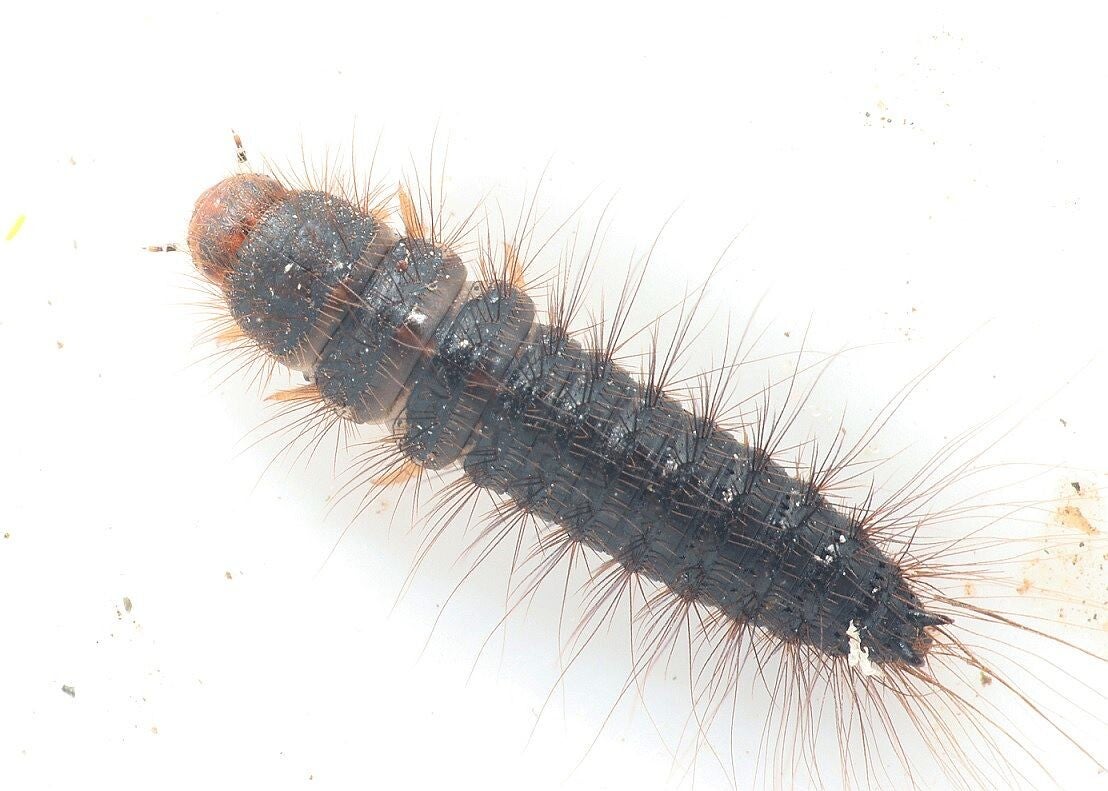
Dermestes gyllenahalii:
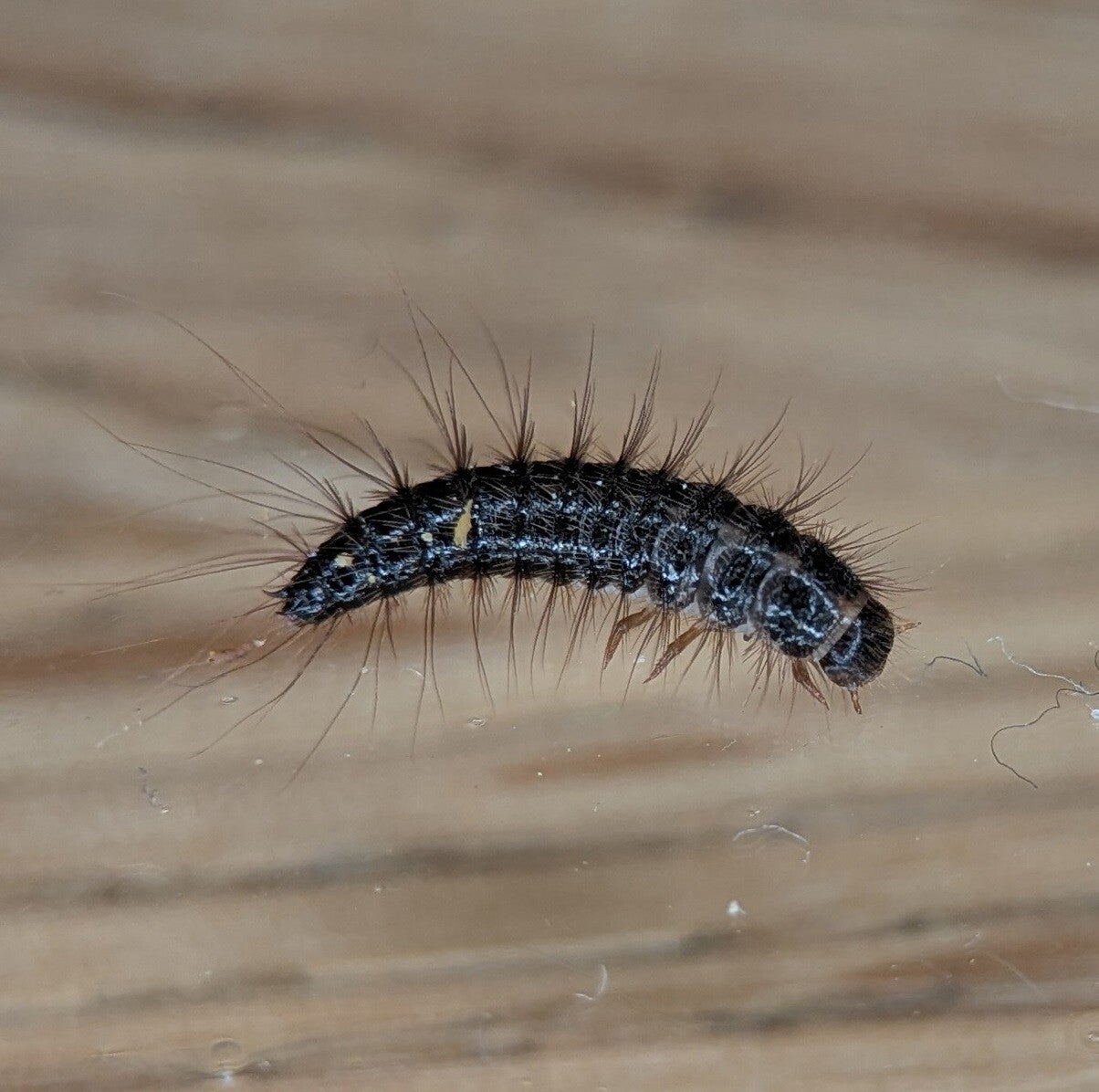
Dermestes laniarius 1:

Dermestes laniarius 2:

Dermestes asiaticus:

Dermestes sardous:
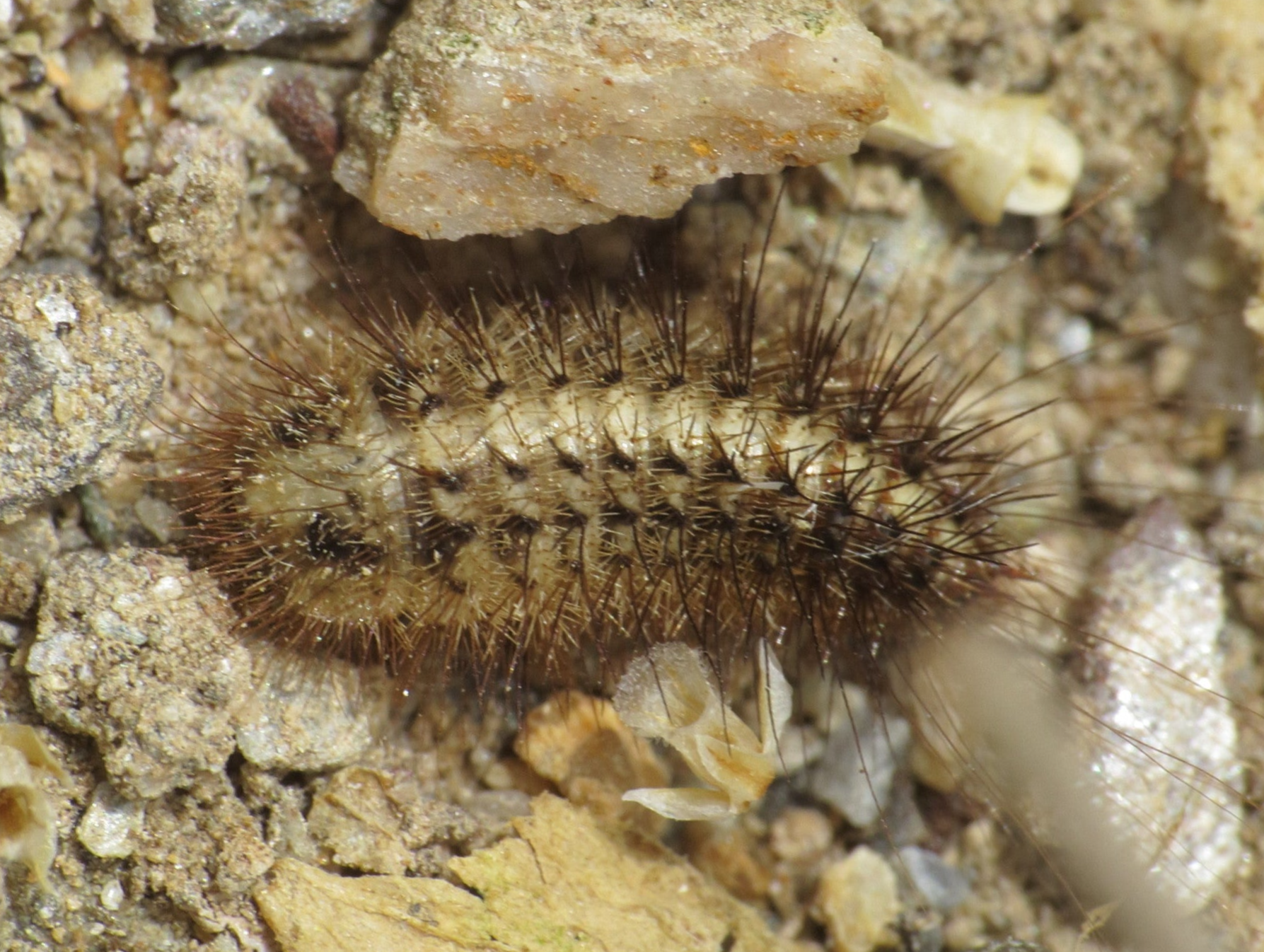
Dermestes kaszabi:
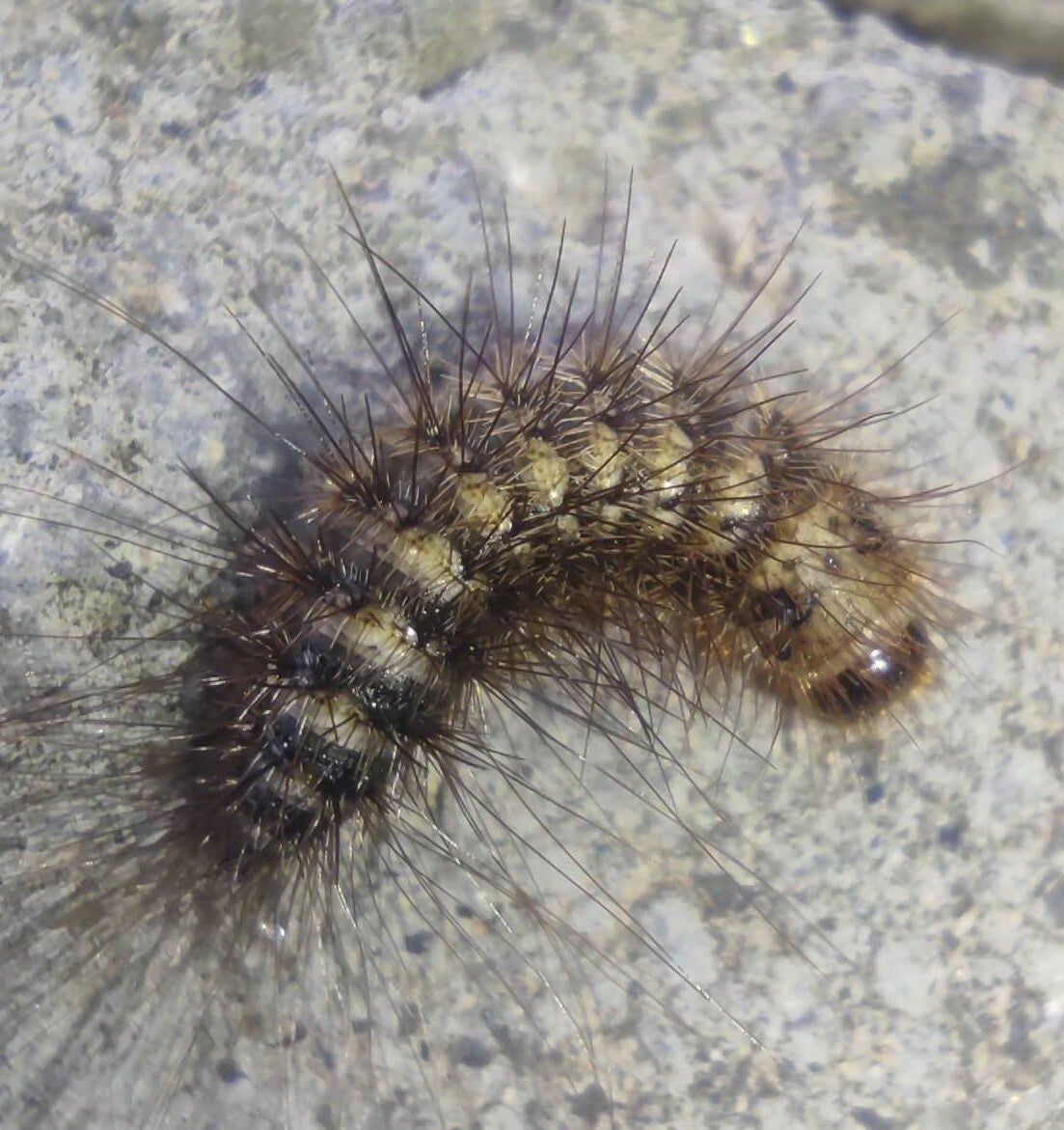
Dermestes intermedius:

Dermestes coronatus:

Dermestes mustelinus (?):
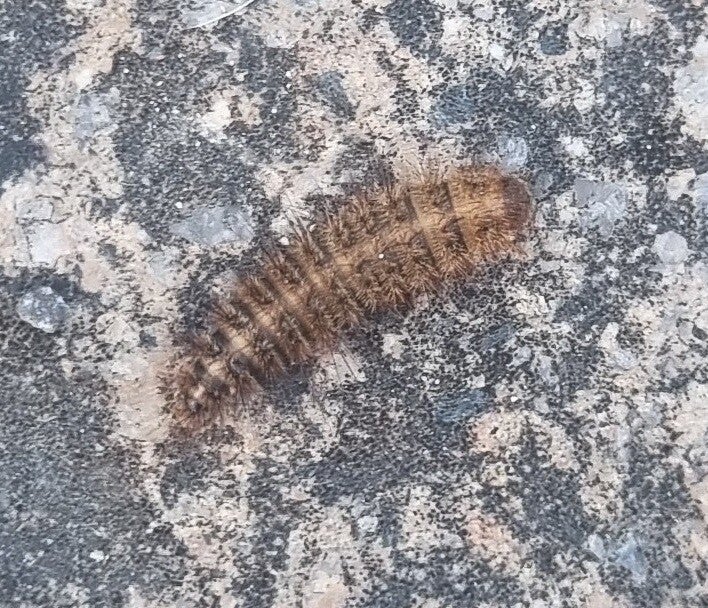
Dermestes erichsoni:
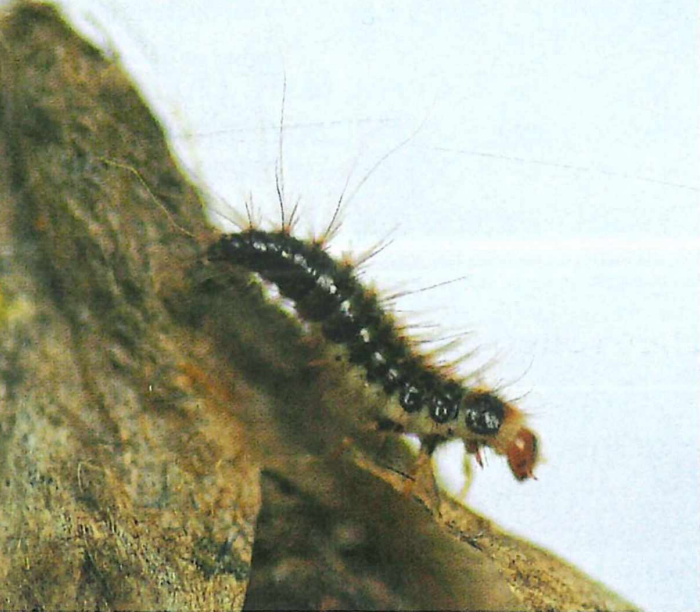
Dermestes aurichalceus:
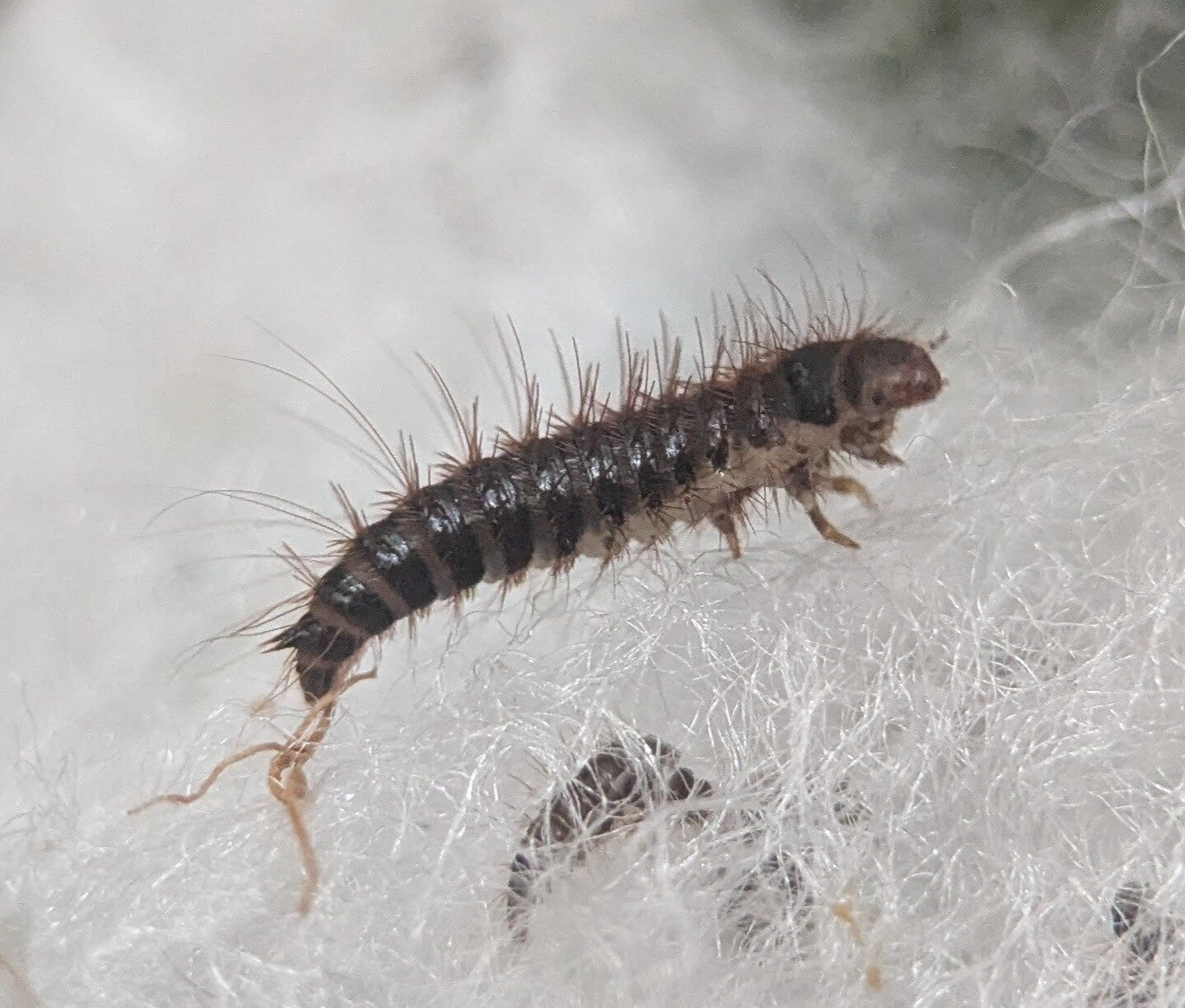
Dermestes tesselatocollis (?):

Dermestes coarctatus:

Dermestes frischii:

Dermestes maculatus:
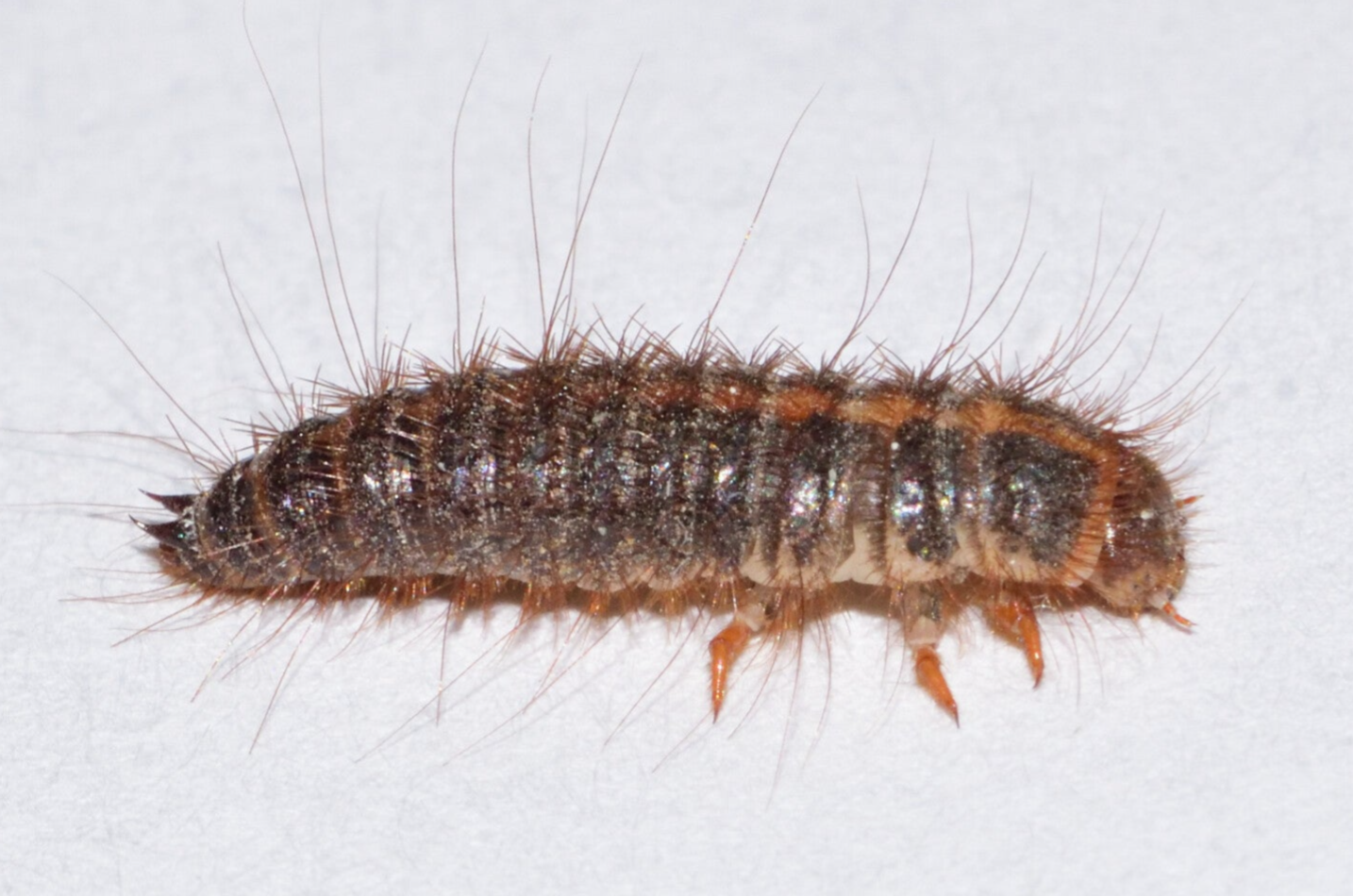
Dermestes carnivorus:
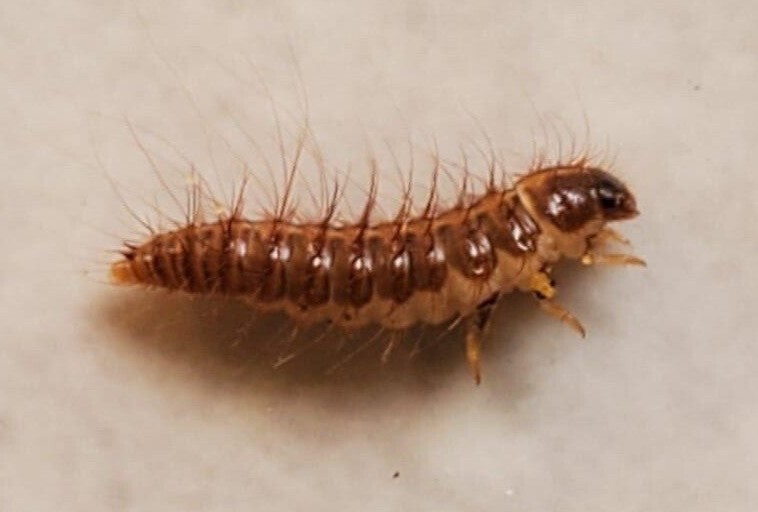
Dermestes marmoratus:
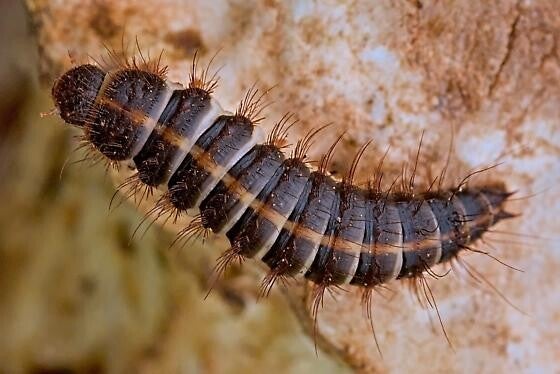
Dermestes caninus:

Dermestes fasciatus:

Dermestes rattus (?):
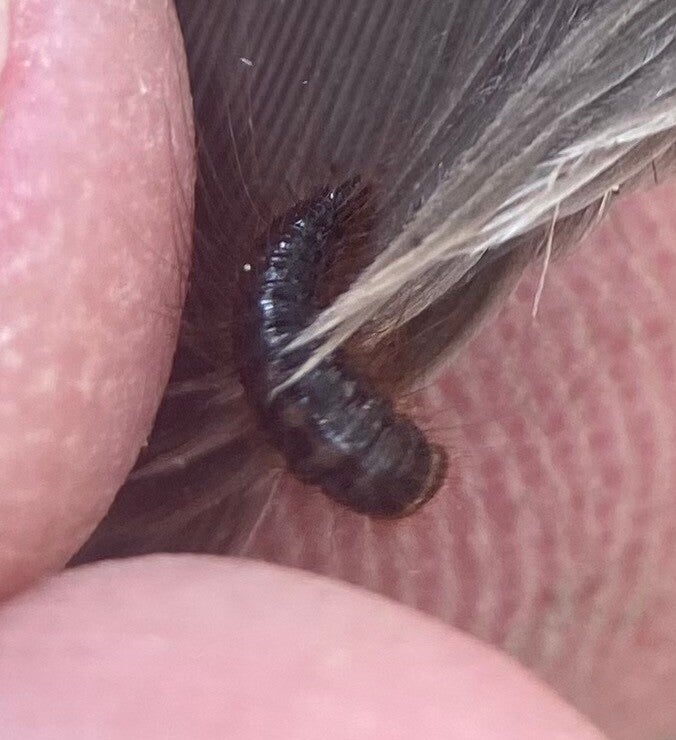
Dermestes talpinus:

Dermestes undulatus:
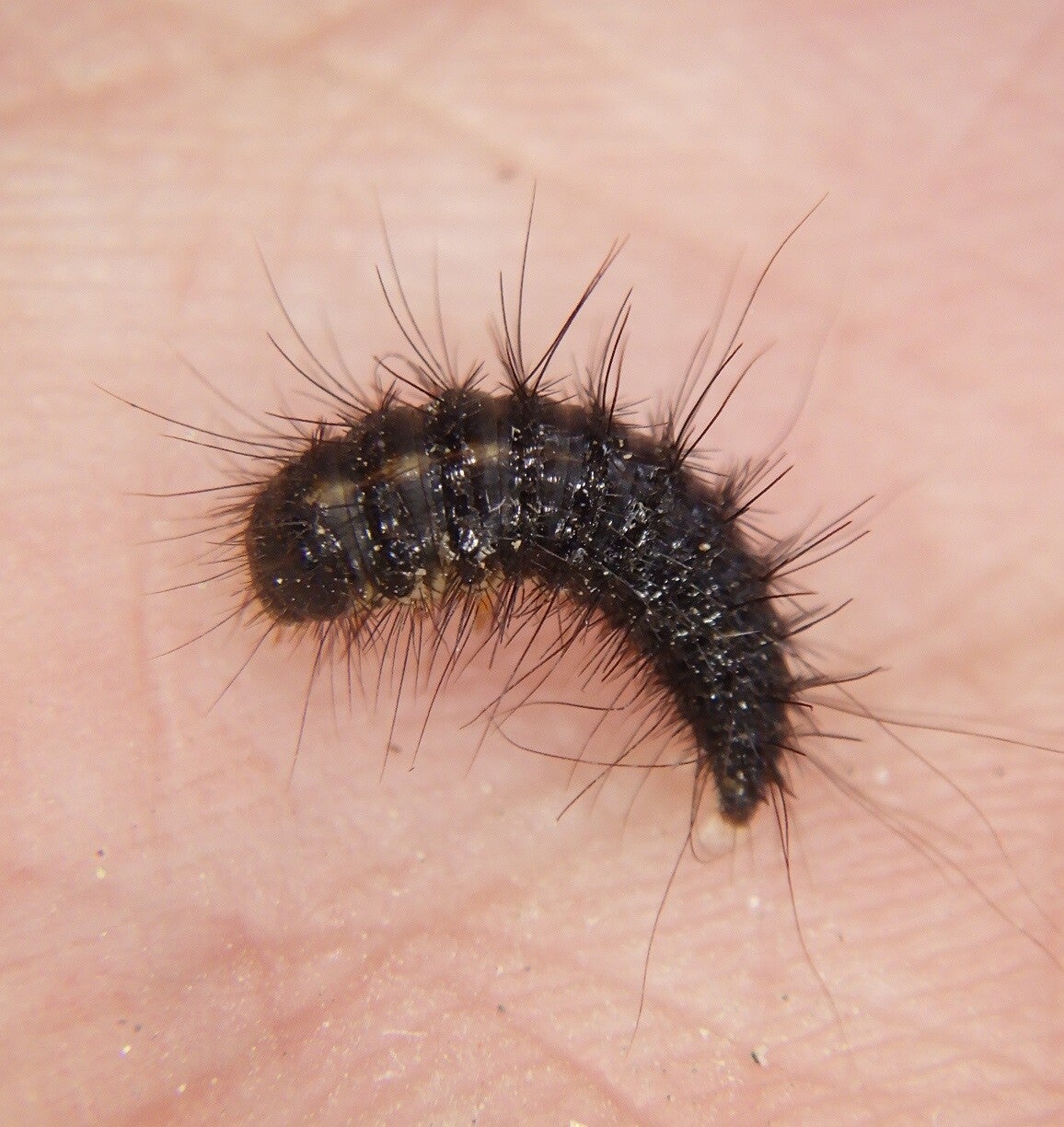
Dermestes murinus:

Mystery larva (Dali, China):

Made by Sarah Mahie
Created on: 17-01-2026
Latest update: 23-09-2026