

Subgenus: Dermestes s. str.
These are the dichotomous keys to identify species of Dermestes (Coleoptera; Dermestidae) on a worldwide scale.
Click on the name of the species group to proceed with the key guide. Click here to go back to the main page.
1b. Very convex body shape; pronotum widest before its midlength, distinctly narrowed. Body robust, slightly depressed, less than 3 times long as wide. Go to species group: fuliginosus
1a. Pronotum widest at base, in some species pronotum parallel-sided in posterior half. Body more elongate and more convex. Go to question: 2
2a. Hairs on the front half of the elytra forming a broad reddish, yellow or greyish band, the hairs so dense that they obscure the black surface underneath; in this band there are three small dark spots on each elytron. Go to species group: lardarius
2b. Elytra without three distinctive dark spots in a basal band on each elytron. Go to question: 3
3a. Posterior lateral corners of pronotum are rounded; striation on the surface of the elytra is absent, shallow or indistinctive, if striation is present it is never furrowed. Go to question: 4
3b. The posterior lateral corners of the pronotum align with the anterior margin of the elytra more closely; surface of the elytra have distinctive striation / no distinct striation, but body two colours: anterior half reddish brown and posterior half black. Go to question: 5
4a. Males have two tufts on abdomen, one on the 3th and one on the 4th abdominal sternite; the base of the pronotum without a border in the middle / if a border is present in the middle, then the pronotum is very black in colour. Go to species group: ater
4b. Males have one tuft located on the 4th abdominal sternite / if a male has two tufts on the abdomen, the first segment of the middle and hind tarsi is about twice as long as the second segment; the base of the pronotum is completely bordered and the outline of the pronotum semicircular. Go to species group: peruvianus
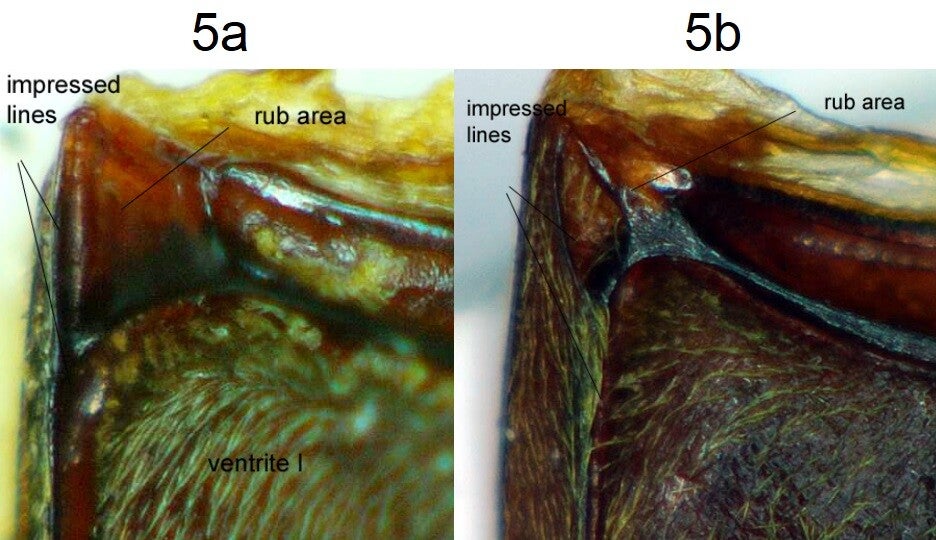
5a. Very narrow structure of lateral depressions and large, flat rub area of the first visible abdominal ventrite. Go to species group: gerstaeckeri
5b. Broad structure of lateral depressions and small rub area of the first visible abdominal ventrite. Go to species group: bicolor


Made by Sarah Mahie
Created on: 30-12-2025
Latest update: 13-01-2026