Species group: bicolor

These are the dichotomous keys to identify species of Dermestes (Coleoptera; Dermestidae) on a worldwide scale.

Click on the species names to go to their taxon page. Click here to go back to the subgenus page. Click here to go back to the main page.

EL/PL = elytral length / pronotal length        EL/EW = elytral length / elytral width (both elytrons)


1a. Body two distinct colours: the head, pronotum, and upper part of the elytra are reddish brown and the rest of the elytra are black; remnants of striation visible on elytra in certain lighting; short body.

Dermestes pulcher


1b. Body more or less one uniform dark colour. Go to question: 2


2a.
Elytra are around or less than 3 times the length of the pronotum. Go to question: 3


2b.
Elytra are more than 3 times longer than the pronotum. Go to question: 6


3a.
 The striation on the elytra is distinctive. Go to question: 4


3b.
The striation on the elytra is shallow. Go to question: 5


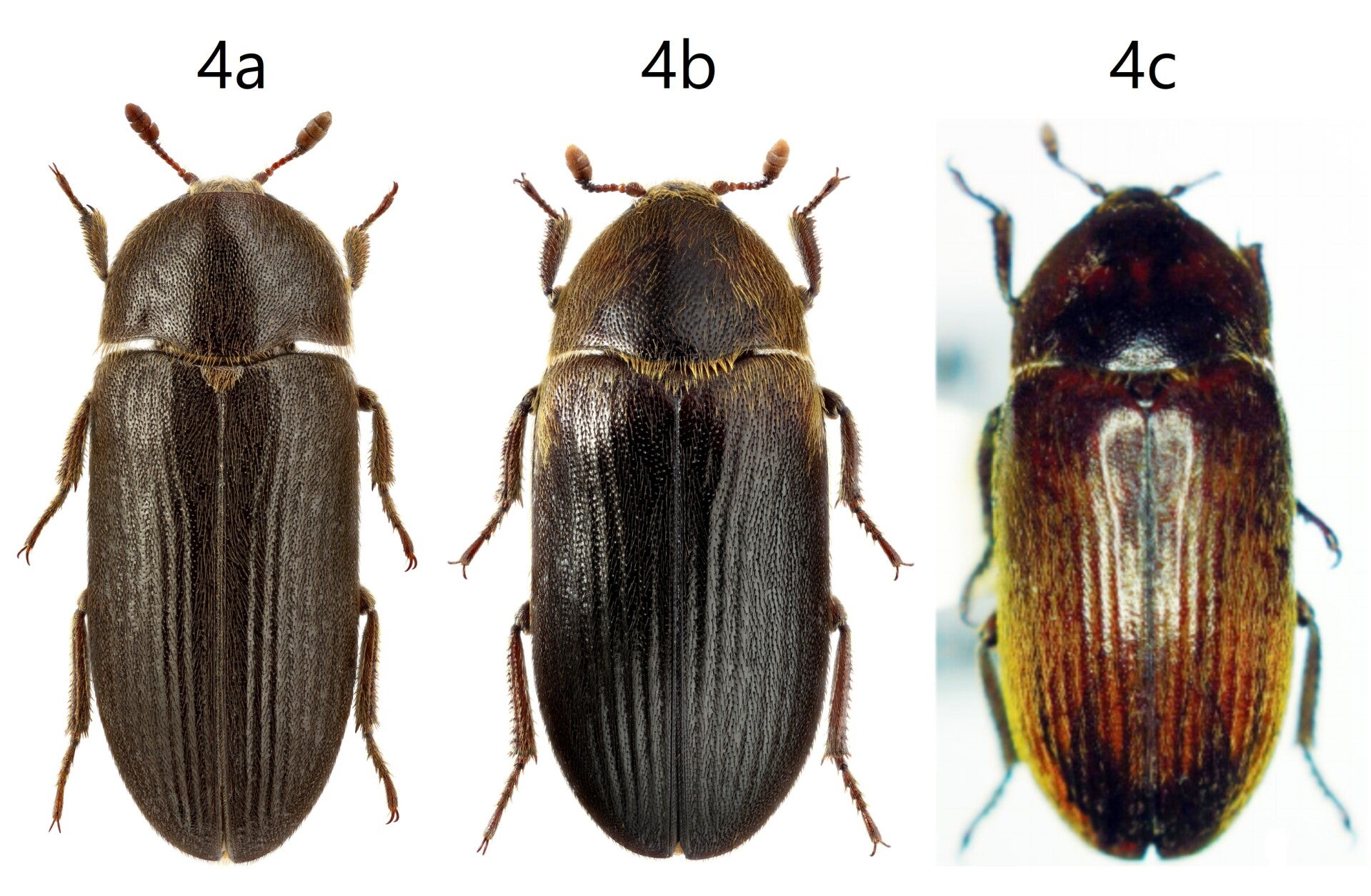
4a.
 Antennal clubs elongated; scutellum kidney-shaped; less convex and more closely punctered pronotum; front and middle tarsi with ventral hairs not forming distinct pads; shape of the lateral depressions in the first visible abdominal sternite.

Dermestes freudei


4b.
Antennal clubs oval; scutellum triangular; more convex and less closely punctered pronotum; front and middle tarsi with ventral hairs forming distinct pads; shape of the lateral depressions in the first visible abdominal sternite. *

Dermestes bicolor bicolor


5a.
 Elytra fairly parallel and covered in yellow hairs; reddish-brown body of 5.5 mm in length; shape of male genitalia. *

Dermestes bicolor impressus


5b.
Elytra slightly convex and densely covered in yellow hairs; each elytron with 6 very flat striae; EL/EW ratio around 1.73; shape of male genitalia.

Dermestes cernyi


5c. Elytra slightly convex and densely covered in brown hairs; each elytron with 10 very flat striae; EL/EW ratio around 1.44; shape of male genitalia.

Dermestes sinensis


6a. The body length is shorter than 8 mm. Go to question: 7


6b. 
The body length is longer than 8 mm. Go to question: 8


7a. Unicolorous yellowish hairs on elytra; shape of male genitalia; shape of the lateral depressions in the first visible abdominal sternite

Dermestes subaenescens


7b. Unicolorous brownish hairs on elytra; shape of male genitalia; shape of the lateral depressions in the first visible abdominal sternite.

Dermestes difficilis


8a.
Abdomen densely covered in long brown-yellow hairs; terminal antennal segment is large; shape of the lateral depressions in the first visible abdominal sternite (very deep and broad); shape of male genitalia.

Dermestes schneideri


8b.
Abdomen not densely enough covered in hairs to conceal surface. Go to question: 9


9a.
 Striation on elytra is shallow; antennal clubs not compact; terminal antennal segment is very small; second segment of middle tarsi is one-fourth in length; shape of the lateral depressions in the first visible abdominal sternite (very flat and narrow); shape of male genitalia.

Dermestes nidum


9b. Striation on elytra is more distinctive; antennal clubs more compact. Go to question: 10


10a. EL/EW ratio is 2 or more; shape of the lateral depressions in the first visible abdominal sternite; shape of male genitalia.

Dermestes amoenus


10b.
EL/EW is less than 2. Go to question: 11


11a.
Antennae brown, last three antennomeres form a short antennal club covered by yellow setae; shape of the lateral depressions in the first visible abdominal sternite; shape of male genitalia.

Dermestes vietnamensis


11b.
Antennae brown, last three last antennomeres forming black antennal club, covered by brown setation. Go to question: 12


12a.
 EL/EW ratio is 1.9; shape of the lateral depressions in the first visible abdominal sternite; structure of antenna; shape of male genitalia.

Dermestes hispanicus


12b. EL/EW ratio is 1.7; shape of the lateral depressions in the first visible abdominal sternite; structure of antenna.

Dermestes laosensis


* It is assumed that the shape of the lateral margins and male genitalia of Dermestes bicolor bicolor and Dermestes bicolor impressus are generally similar in shape due to their subspecies status.

Used images:

Image of key 1:
- Daniel S. 2020: Dermestes pulcher. Link.

Image of key 4a (dorsal):
- М.Э. Смирнов, no date: Dermestes freudei Kalik & Ohbayashi, 1982 (Dermestidae). Link.

Image of key 4b (dorsal):
- Макаров К.В., no date: Dermestes bicolor. Link.

Image of key 4a (lateral margin):
- Kalík V. & Ohbayashi N. 1982: A new Dermestid Beetle from Asia (Coleoptera). Entomological Revue of Japan 37: 65-67. Link.

Image of key 4b (lateral margin):
- Háva J. 2019: Redescription of holotype Dermestes impressus Pic, 1898 (Coleoptera: Dermestidae: Dermestinae: Dermestini). Euroasian Entomological Journal 18(1): 75-76. Link.

Images of key 5 (male genitalia):
- Háva J. 2009: Dermestidae (Coleoptera) from the collection of the Czech entomologist Zdeněk Černý. Baltic Journal of Coleopterology 9: 119-123. Link.

Image of key 5b (dorsal):
- Kimyonazarov S. 2023: Coleoptera. Link.

Images of key 7a (dorsal), 8a (dorsal & abdomen) and 10a (dorsal):
- Herrmann A. no date: Pictures of some Dermestid Species. Link.

Image of key 7 (lateral margins and male genitalia):
- Háva J. 2007: Contribution to the „Dermestes bicolor species group“ from the Neotropical region (Coleoptera: Dermestidae). Studies and Reports of District Museum Prague-East, Taxonomical Series 3: 43-46. Link.

Image of key 8a (lateral margin):
- Háva J. 2008: A contribution to the Dermestidae (Coleoptera) from the Natural History Museum Basel. Entomologica Basiliensia et Collectionis Frey 30: 35-39. Link.

Image of key 8a (male genital) and 9a (male genital):
- Háva J. 2004: Notes on Dermestidae (Coleoptera) with new synonyms and description of three new species. Annales Historico-Naturales Musei Nationalis Hungarici 96: 81-95. Link.

Image of key 9a (dorsal):
- Padon L. 2022: Dermestes nidum. Link.

Image of key 9a (antennae):
- Strickland O. 2020: Dermestes nidum. Link.

Images of 10a (lateral margins) and 11a:
- Háva J. 2022: A new species in the Dermestes bicolor species group from Vietnam (Coleoptera: Dermestidae: Dermestinae). Munis Entomology and Zoology 17(2): 694-697. Link.

Image of key 12a (dorsal):
- Prieto-Manzanares M. & Herrmann A. 2019: New records of Dermestid beetles (Coleoptera, Dermestidae) from the Iberian Peninsula and the Balearics. Boletín de la Real Sociedad Española de Historia Natural 113: 19-28. Link.

Images of key 12 (lateral margins and antennae):

- Háva J. 2004: Dermestes (Dermestes) laosensis sp. nov. (Coleoptera: Dermestidae) from Laos. Acta Societatis Zoologicae Bohemicae 68: 81-82. Link.

Used information:

- (1) LeConte J. L. 1854: Synopsis of the Dermestidae of the United States. Proceedings of the Academy of the Natural Sciences of Philadelphia 7: 106-113. Link.
- (2, 3a and 10a) Prieto-Manzanares M. & Herrmann A. 2019: New records of Dermestid beetles (Coleoptera, Dermestidae) from the Iberian Peninsula and the Balearics. Boletín de la Real Sociedad Española de Historia Natural 113: 19-28. Link.
- (2 and 7a) Zhantiev R. D. 1976: Жуки-кожееды (семейство Dermestidae) фауны СССР. [The skin eaters family Dermestidae of fauna of the USSR.] Moskva: Izdatelstvo Moskovskogo Universiteta, 180 p. Link.
- (3a and 5) Háva J. 2009: Dermestidae (Coleoptera) from the collection of the Czech entomologist Zdeněk Černý. Baltic Journal of Coleopterology 9: 119-123. Link.
- (4a and 9a) Kalík V. & Ohbayashi N. 1982: A new Dermestid Beetle from Asia (Coleoptera). Entomological Revue of Japan 37: 65-67. Link.
- (5a) Háva J. 2019: Redescription of holotype Dermestes impressus Pic, 1898 (Coleoptera: Dermestidae: Dermestinae: Dermestini). Euroasian Entomological Journal 18(1): 75-76. Link.
- (5c) Háva J. 2004: New and interesting Dermestidae (Coleoptera) from China. Entomologische Zeitschrift, Stuttgart 114: 225-232. Link.
- (8a, 11 and 12) Háva J. 2022: A new species in the Dermestes bicolor species group from Vietnam (Coleoptera: Dermestidae: Dermestinae). Munis Entomology and Zoology 17(2): 694-697. Link.
- (9a) Háva J. 2004: Notes on Dermestidae (Coleoptera) with new synonyms and description of three new species. Annales Historico-Naturales Musei Nationalis Hungarici 96: 81-95. Link.
- (10a) Háva J. 2008: A contribution to the Dermestidae (Coleoptera) from the Natural History Museum Basel. Entomologica Basiliensia et Collectionis Frey 30: 35-39. Link.
- (11) Háva J. 2004: Dermestes (Dermestes) laosensis sp. nov. (Coleoptera: Dermestidae) from Laos. Acta Societatis Zoologicae Bohemicae 68: 81-82. Link.


Made by Sarah Mahie

Created on: 30-12-2025

Latest update: 07-02-2026