

Subgenus: Dermestes
These are the dichotomous keys to identify larvae of the genus Dermestes (Coleoptera; Dermestidae) on a worldwide scale.
Click here to go back to the main page.
1a. Dorsal surface with prominent longitudinal stripe. Go to question: 2
1b. Dorsal surface without prominent longitudinal stripe. Go to question: 3
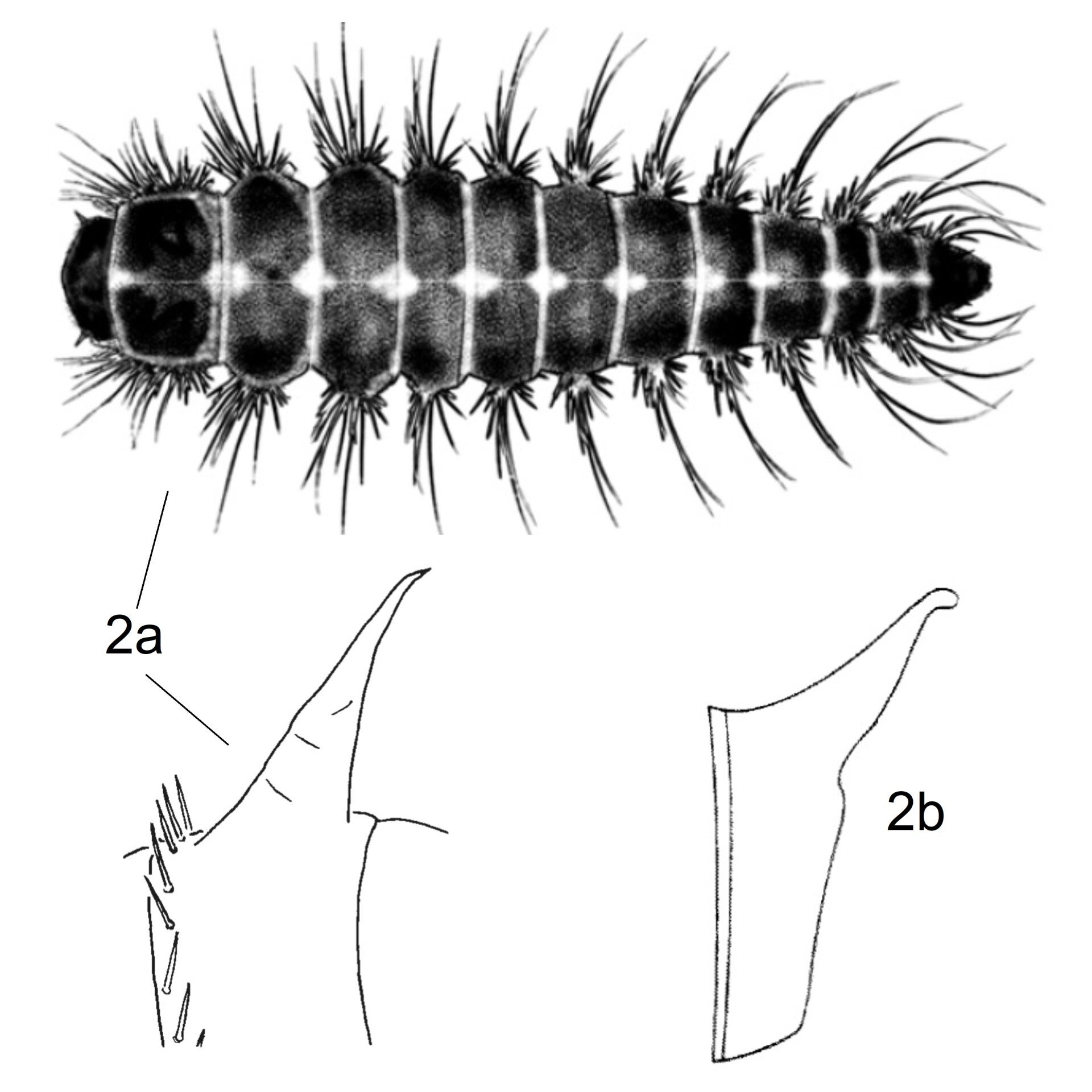
2a. Dorsal surface with a light longitudinal beaded stripe, the biggest 'beads' on the anterior half of the body. Urogomphi almost straight in side view. Head without two frontal tubercles. (Species group: ater)
→ Dermestes ater
2b. Dorsal surface with a broad, light, longitudinal stripe, borders irregular, extending posteriorly from anterior margin of mesonotum, becoming less definite posteriorly. The urogomphi are curved upward then recurved caudally, forming a small terminal hook. Head without two frontal tubercles. (Species group: bicolor) Go to question: 7
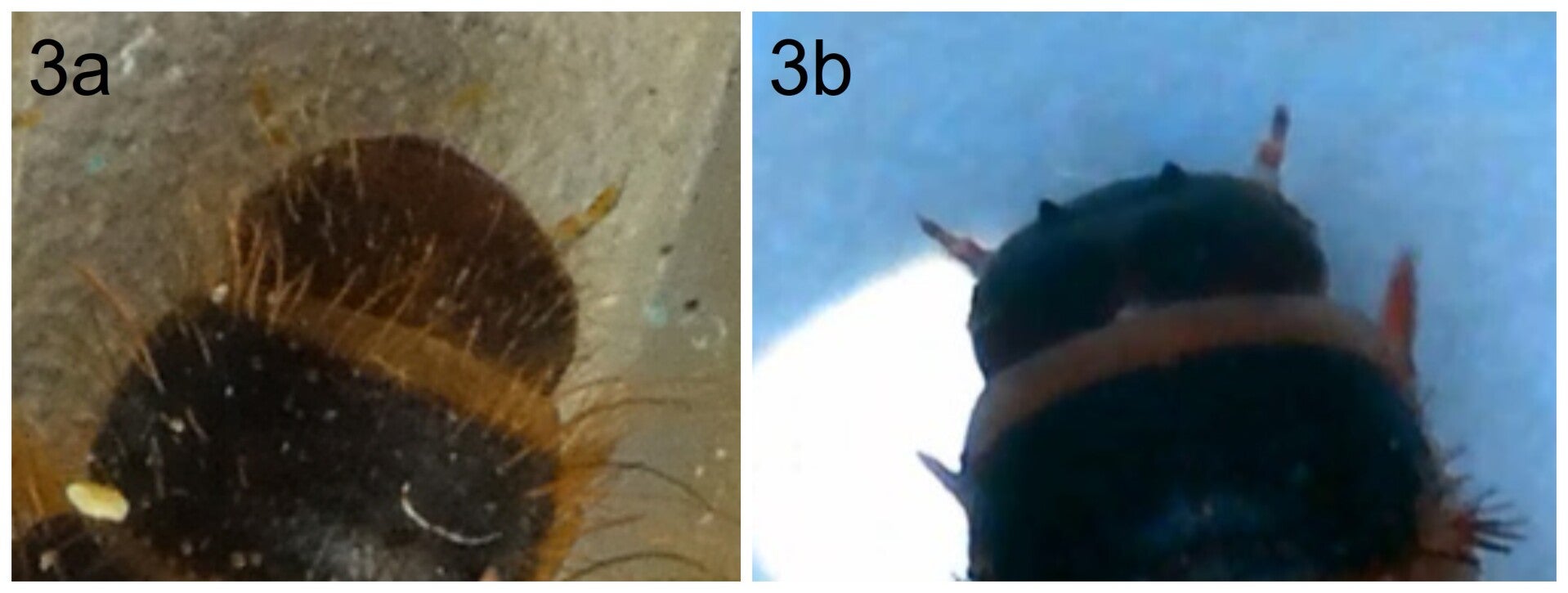
3a. Head without two frontal tubercles. (Species group: lardarius) Go to question: 4
3b. Head with two frontal tubercles. (Species group: peruvianus) Go to question: 5
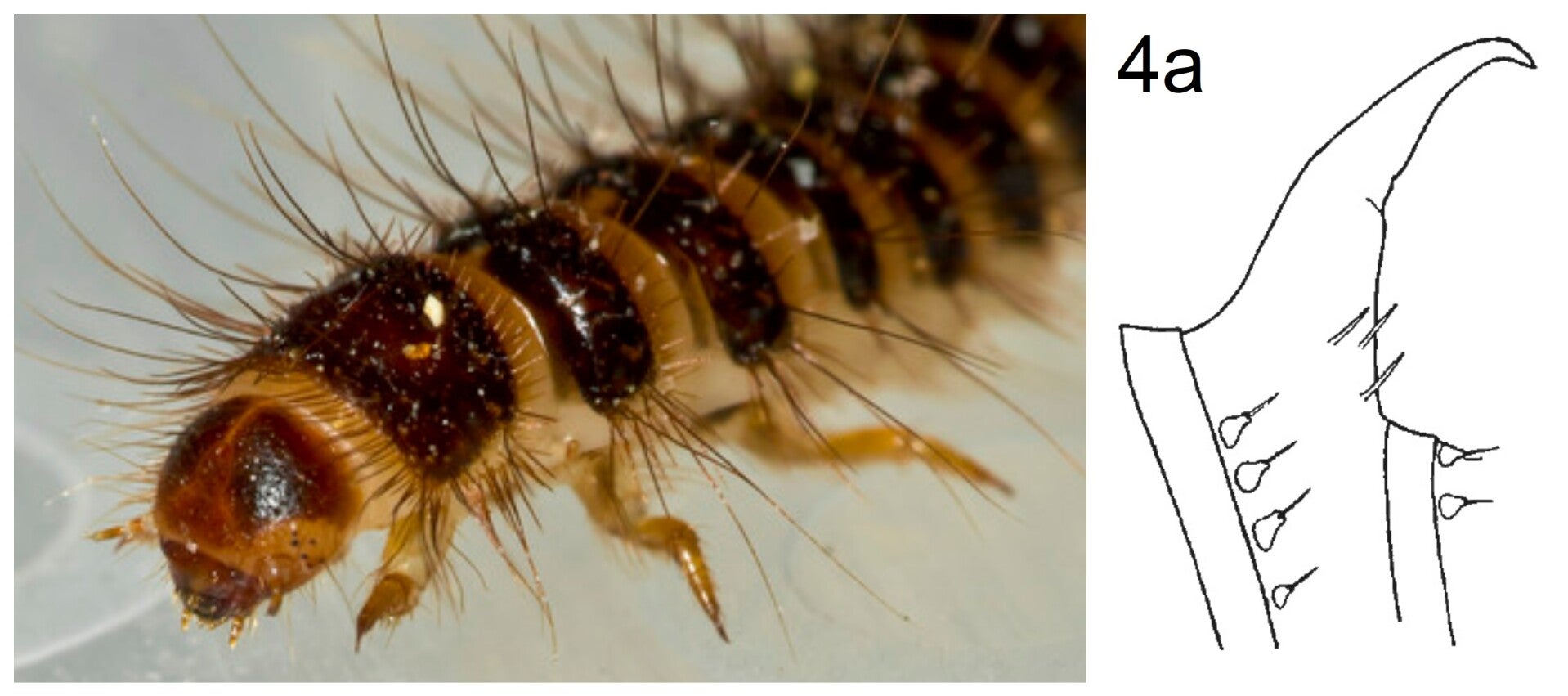
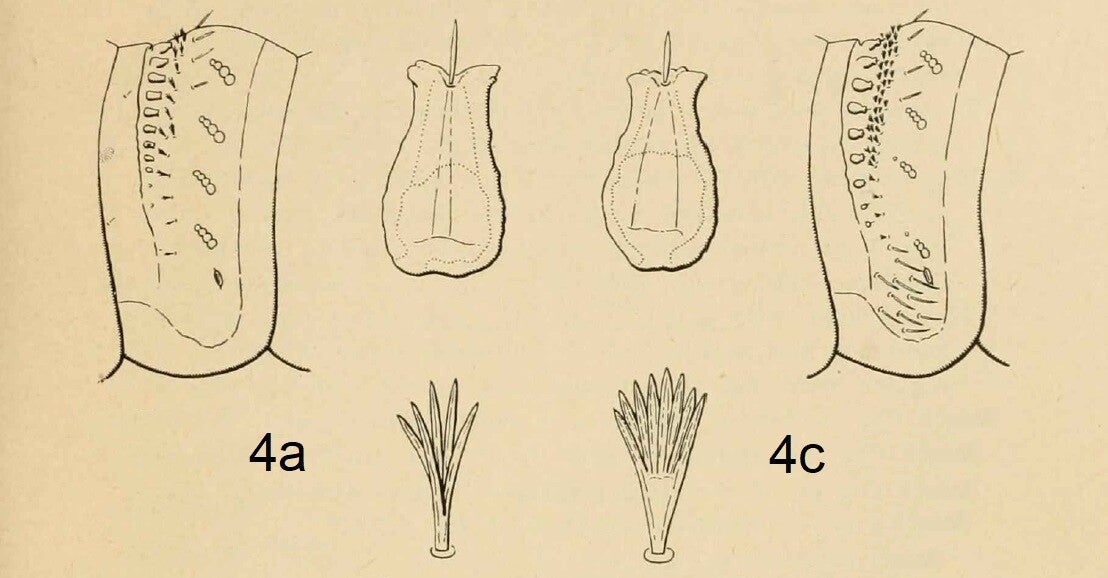
4a. The sides of the thoracic tergites are not pigmented. The posterior edges of the abdominal tergites are covered with setae of approximately equal length. Body dorsally uniformly pigmented, only fine eleavage line present on dorsum. An anterior series of fully developed retrorse tubercles on abdominal tergites 3 to 10. Abdominal tergite 3 to 8 each with a transverse series, composed of somewhat a single row, ramous setae with few rami. Urogomphi curved towards the top, together they form a "U" as seen from above.
→ Dermestes lardarius
4b. The sides of the thoracic tergites are usually pigmented. The posterior edges of the abdominal tergites are covered with setae of varying length. Urogomphi similar to D. lardarius.
→ Dermestes vorax
4c. The sides of the thoracic tergites are not pigmented. Body dorsally with narrow, indistinct, yellowish, median stripe extending posteriorly rom the anterior margin of the pronotum. The cuticle of the tergite is darker than the ventral side of the larva. An anterior series of fully developed retrorse tubercles on abdominal tergites 4 to 10. Abdominal tergite 3 to 8 each with a transverse series of several rows of numerous, bushy ramous setae with many rami. Urogomphi with a small kink around the middle, together they form a "U" as seen from above.
→ Dermestes signatus
4d. More data is needed. The sides of the thoracic tergites are usually pigmented. The cuticle of the tergite is the same colour as the ventral side of the larva. An anterior series of fully developed retrorse tubercles on abdominal tergites 4 to 10. The urogomphi more or less straight and slightly curved towards the top, together they form a "V" as seen from above .
→ Dermestes reductus
5a. Abdominal tergites 4-8 with a transverse series of very numerous short normal setae immediately posterior to the row of retrorse tubercles (these setae are also present on 2 and 3 although the retrorse tubercles are not).
→ Dermestes leechi
5b. Abdominal tergites 4-8 with sparse short erect normal setae posterior to the row of retrorse tubercles, or with a transverse series of very numerous, short ramous setae. Go to question: 6
6a. Fontal tubercles conspicuous. Shape of the urogomphi. Retrorse tubercles on abdominal tergites 3 to 10 well developed.
→ Dermestes haemorrhoidalis
6b. Frontal tubercles obliterated, hardly perceptible. Shape of the urogomphi. Retrorse tubercles on abdominal tergites 3 to 10 absent or inconspicuous.
→ Dermestes peruvianus
7a. The length of the urogomphi is approximately twice the width at the base (see image of key 2b). The upper surface is brown, forehead entirely light.
→ Dermestes bicolor
7b. Urogomphi widely separated and slender. An anterior series of fully developed retrose tubercles on abdominal tergites 4 to 9, tubercles terminally with wartlike processes and terminal seta. Abdominal tergites 4 to 8 each with transverse series of numerous, compactly grouped, short, normal setae immediately posterior to retrorse tubercles. Abdominal tergites 4 to 8 with many, short, spiny, capitate setae, short setae of other tergites not capitate.
→ Dermestes nidum


Additional images:
Dermestes ater:

Dermestes bicolor:

Dermestes nidum (?):

Dermestes pulcher (?):

Dermestes haemorrhoidalis:

Dermestes peruvianus (?):

Dermestes lardarius:

Dermestes vorax:

Dermestes signatus:


Made by Sarah Mahie
Created on: 17-01-2026
Latest update: 23-02-2026