

In the original species description of Dermestes hankae, this species is compared with the very similar looking Dermestes pardalis. What appeared as a clear differentiation between two species on the surface, hid a taxonomical mystery. Do these species need to be revised? + The first photos of "D. pardalis".
In the photo gallery of Dermestidae expert Andreas Herrmann, the taxon page of Dermestes pardalis Billberg in Schönherr 1808 is still missing. Throughout the years, he surprisingly never encountered a specimen of this species (A. Herrmann, personal communication, February 28, 2026). This is surprising, because the species should be present in Corsica, Germany, Portugal, Sardinia, Spain, Algeria, Morocco and Tunisia (Háva 2025). Dermestes hankae Háva 1999 has a smaller documented range, being present in France, Italy, Spain and Algeria (Háva 2025). The fact that D. hankae has been observed a lot more than D. pardalis, even though the former species has been described much later, might have been the first clue that something is going on.
Herrmann has several specimens of D. hankae in his collection and this species has multiple sightings on Observation.org, whereas not a single photo of D. pardalis could be found online before this search started. There were two uploads of D. pardalis specimens with photos on GBIF, but the ventral pattern would suggest that at least one of them is an misidentified D. hankae specimen (fig. 1) and the other specimen if from France where D. pardalis shouldn't be present (Natural Hisotry Museum London 2024a & 2024b, Háva 2025). The ventral pattern is a key difference between D. pardalis and D. hankae in the original species description of the latter (Háva 1999b).

Fig. 1: D. pardalis or a misidentified D. hankae? Note the white spot on the last abominal sternite reaching the posterior edge. Source: Natural History Museum London 2024b.

Fig. 2: Illustrations from the species description of Háva (1999b); A) Ventral pattern designated to Dermestes hankae; B) Ventral pattern designated to Dermestes pardalis; Photo of a specimen from the NHMR collection; C) Ventral pattern.

Fig. 3: Illustrations from the species description of Háva (1999); A) Aedeagus shape designated to Dermestes hankae; B) Aedeagus shape designated to Dermestes pardalis; Photo by A. Herrmann of a specimen from the AHEC collection; C) Aedeagus.
The search for a photo of an actual D. pardalis had begun and I made enquiries to collection holders for photographs of their D. pardalis specimens. The gathered data was confusing to say the least. The largest part of specimens (±83%) appeared to be D. hankae instead. Perhaps not surprising, since many specimens were collected and identified before the species D. hankae was even described. However, in collections with almost identical labels, both species could be intermixed present. One syntype of D. pardalis is stored in the NHRS collection, but low and behold: the photos of the syntype suggested this specimen to be D. hankae instead, according to Háva’s illustrations.
What to do if a syntype does not match the species' description?

Fig. 4

Fig. 5

Fig. 6

Fig. 7

Fig. 8
Fig. 4: The D. pardalis syntype, with a hankae ventral pattern. Source: Álvarez Covelli on behalf of the Swedish Museum of Natural History 2026.
Fig. 5: A specimen with a pardalis ventral pattern. Source: Malinen on behalf of the Finnish Museum of Natural History 2026.
Fig. 6: A specimen with a pardalis ventral pattern. Source: Mattila on behalf of the Finnish Museum of Natural History 2026.
Fig. 7: A specimen with a hankae ventral pattern. Source: Borer on behalf of Naturhistorisches Museum, Basel, Switzerland 2026.
Fig. 8: The abdomen of three specimens from the same collection. Source: Volkovitsh on behalf of the Zoological Institute of the Russian Academy of Sciences 2026.
The species D. pardalis does not occur in France according to the World Catalogue of Dermestidae (Háva 2025), however this does not align with the fact that the synonymous D. thoracicus Dejean 1821 was described from southern France. D. hankae was also described from France, making their synonymous status very likely. The type specimen of D. thoracicus Géne 1836 that was stored in the MRSN collection was already destroyed before 1970 (M. Ruzzon on behalf of Museo Regionale di Scienze Naturali, personal communication, March 5, 2026), so no comparison between specimens could be made.
Can the different ventral patterns simply be varieties of the same species? The species Dermestes tesselatocollis and Dermestes nan are examples of species of whom the pattern on the last abdominal sternite can be very variable (Háva 1999a, Háva 2002). Both species were considered subspecies at first, due to their externally very similar appearance. The apex of the last abdominal sternite of both species can either be solid black or the white hairs present at the anterior side of the sternite can reach all the way to the posterior edge of the sternite (see fig. 10).
In the original species description of D. hankae there are two other traits mentioned that should differ between the species in question and D. pardalis: the colour of the antennae and the shape of the aedeagus.
The antennae of D. hankae are supposed to be brown-black with the first antennal segment black and the antennae of D. pardalis are supposed to be entirely brown (Háva 1999b). After comparing the colour of the antennae and in particular the colour of the first antennal segments, the difference between brown and black was deemed too difficult to differentiate.
Since no photo of an aedeagus from a beetle with a pardalis ventral pattern was obtained, no comparison could be made. It is noteworthy that the aedeagus of the beetles with a hankae ventral pattern are quite variable in shape.
Two other traits that might be worth looking into, are the shape of the black spots on the lateral sides of the first abdominal sternite (partially devided by a white streak / solid black) and the colour of the hairs on the abdomen (white / pale yellow).

Fig. 9: The antennae of specimens with a pardalis ventral pattern (1, 2) and a hankae ventral pattern (3, 4, 5, 6). Sources:
1 = Malinen on behalf of the Finnish Museum of Natural History 2026.
2, 4, 5 = Borer on behalf of Naturhistorisches Museum, Basel, Switzerland 2026.
3 = Álvarez Covelli on behalf of the Swedish Museum of Natural History 2026.
6 = Vorst on behalf of Nationaal Natuurhistorische Museum, Leiden, The Netherlands 2026.
Tab. 1: All examined material that could be identified on their ventral pattern as proposed by Háva (1999).
| Collection holder | Specimen number | Country of origin | Ventral pattern according to Háva (1999) |
|---|---|---|---|
| MRSN | Holotype D. thoracicus | France | x |
| NHRS | Syntype D. pardalis: NHRS-JLKB000027462 | Outside Europe | hankae |
| AHEC | 6 specimens: 108a, 108b, 109, 110, 2215, 6287 | Spain | hankae |
| AHEC | 1 specimen: 213 | Algeria | hankae |
| BMNH | 1 specimen: NHMUK015558703 | Iberian Peninsula | hankae |
| MZHF | 2 specimens: GAC 40905, GAC 40906 | France | hankae |
| MZHF | 1 specimen: GAC 40907 | Spain | hankae |
| MZHF | 1 specimen: GAC 40908 | Morocco | pardalis |
| MZHF | 2 specimens: GAC 40909, GAC 40910 | Algeria | pardalis |
| NHMB | 1 specimen: NMB_Algerien | Algeria | pardalis |
| NHMB | 2 specimen: NMB_Frey_Avignon, NMB_Frey_P_O_P_Vendres | France | hankae |
| NHMR | 1 specimen: NMR996300139773 | Spain | hankae |
| RMNH | 1 specimen: RMNH.INS.1493236 | Algeria | hankae |
| RMNH | 1 specimen: RMNH.INS.1493254 | Spain | hankae |
| ZMAS | 1 specimens | Algeria | pardalis |
| ZMAS | 3 specimens | Algeria | hankae |
| ZMAS | 1 specimen | France | pardalis |
| ZMAS | 9 specimens | France | hankae |
| Observation.org | 2 specimens: 324489380, 324670924 | Spain | hankae |
References:
-
Álvarez Covelli M. A. on behalf of the Swedish Museum of Natural History 2026. Photo of Dermestes pardalis (syntype): NHRS-JLKB000027462. © 2026 Naturhistoriska riksmuseet. Original photo cropped. Made available under the Creative Commons Attribution 4.0 International Public License, CC-BY 4.0. Link.
-
Billberg in Schönherr C. J. 1808: Synonymia Insectorum, oder: Versuch einer Synonymie Aller bisher bekannten Insecten; nach Fabricii Systema Eleutheratorum &c. geordnet. Mit Berichtigungen und Anmerkungen, wie auch Beschreibungen neuer Arten und illuminirten Kupfern. Erster Band. Eleutherata oder Käfer. Zweiter Theil. Stockholm, F. C. Marquard, 423 pp. Link.
-
Borer M. on behalf of Naturhistorisches Museum, Basel, Switzerland 2026: Photos of Dermestes pardalis, Dermestes_pardalis_NMB_Frey_P_O_P_Vendres_3, Dermestes_pardalis_NMB_Algerien_2, Dermestes_pardalis_NMB_Frey_Avignon_2, Dermestes_pardalis_NMB_Frey_P_O_P_Vendres_2.
-
Dejean P. F. M. A. 1821: Catalogue de la collection de Coléoptères de M. le Baron Dejean. Paris: Crevot, viii + 136 + 2 pp. Link.
-
Gené J. 1836: De quibusdam Insectis Sardiniae novis aut minus cognitis. Fasciculus I. Taurini, 39 pp. Link.
-
Háva J. 1999a: Contribution to the knowledge of Old World Dermestidae (Coleoptera). Part 1: Genus Dermestes. Folia Heyrovskyana 7: 133-140. Link.
-
Háva J. 1999b: Contribution to the knowledge of Old World Dermestidae (Coleoptera). Part 2: Genus Dermestes. Folia Heyrovskyana 7: 141-150. Link.
-
Háva J. 2002: Contribution to the knowledge of Old World Dermestidae Part 3: Dermestes (Insecta: Coleoptera). Reichenbachia 34: 303-307. Link.
-
Háva J. 2025: World Catalogue of the Dermestidae (Coleoptera). Únětice/Praha: Private Entomological Laboratory and Collection, 368 pp. Link.
-
ICZN 1999: International Code of Zoological Nomenclature. Fourth Edition. The International Trust for Zoological Nomenclature, London, UK. 306 pp. Link.
-
Malinen P. on behalf of the Finnish Museum of Natural History 2026: Photo of Dermestes pardalis: GAC.40910. © 2026 Luomus. Original photo cropped. Made available under the Creative Commons Attribution 4.0 International Public License, CC-BY 4.0. Link.
-
Mattila J. on behalf of the Finnish Museum of Natural History 2026: Photo of Dermestes pardalis, GAC.40909. © 2026 Luomus.
-
Natural History Museum London 2024a: GBIF, Dermestes pardalis Billberg, 1808. NHMUK015558702. Link.
-
Natural History Museum London 2024b: GBIF, Dermestes pardalis Billberg, 1808. NHMUK015558703. Link.
-
Volkovitsh M. on behalf of Zoological Museum, Academy of Sciences, St.-Petersburg, Russia 2026: ventral photos of three Dermestes pardalis specimens.
-
Vorst O. on behalf of Nationaal Natuurhistorische Museum, Leiden, The Netherlands 2026: Photo of Dermestes pardalis, RMNH.INS.1493236_front.
List of collection holders:
MRSN = Museo Regionale Scienze Naturali, Torino, Italy
NHRS = Naturhistoriska Riksmuseet Stockholm, Sweden
AHEC = Andreas Herrmann’s Private Collection
BMNH = Natural History Museum, London, United Kingdom
MZHF = Finnish Museum of Natural History, Helsinki, Finland
NHMB = Naturhistorisches Museum, Basel, Switzerland
NHMR = Natural History Museum Rotterdam, The Netherlands
RMNH = Nationaal Natururhistorische Museum, Leiden, The Netherlands
ZMAS = Zoological Museum, Academy of Sciences, St.-Petersburg, Russia
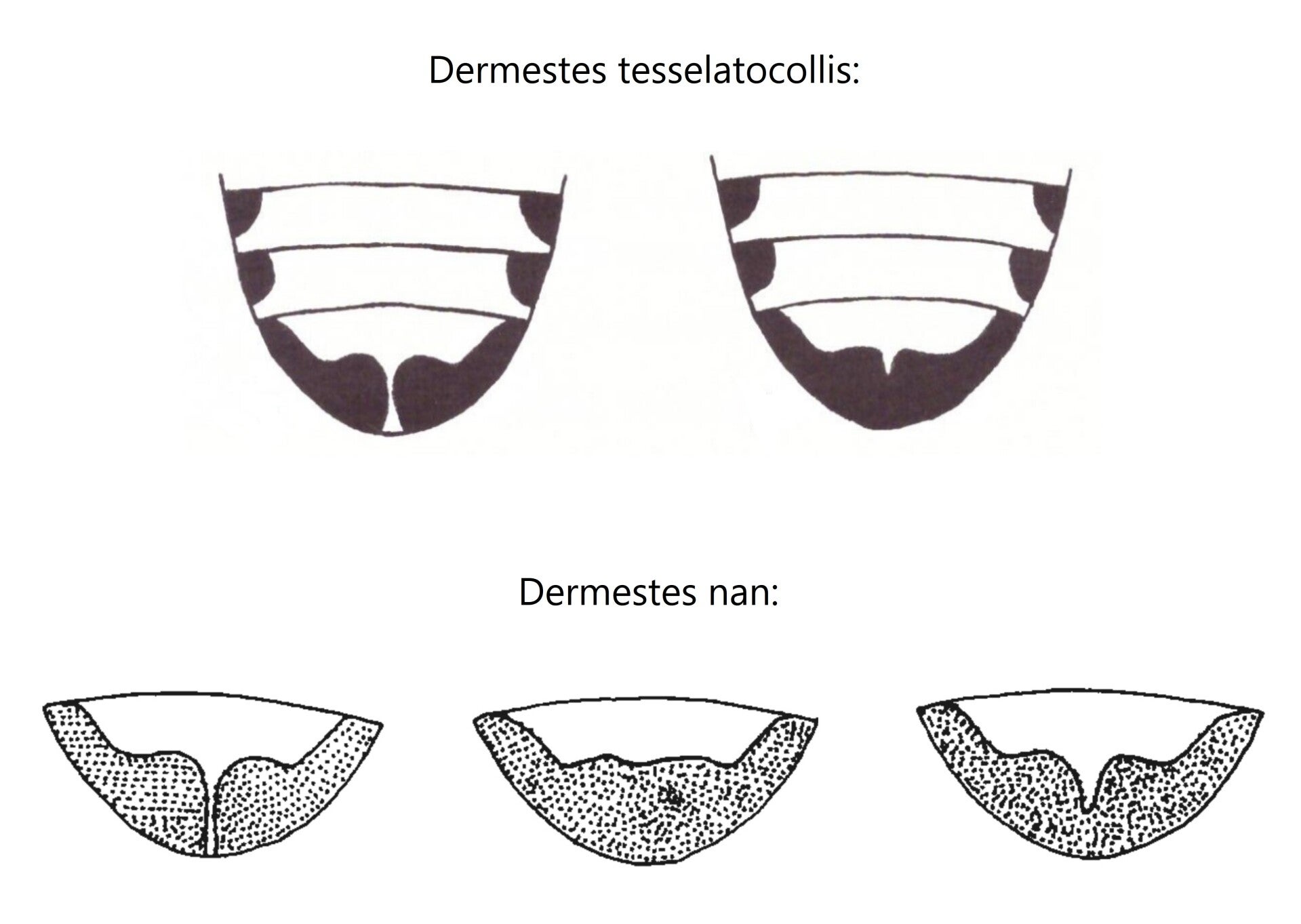
Fig. 10: The variety in ventral pattern of Dermestes tesselatocollis (Háva 1999) and Dermestes nan (Háva 2002).
Add comment
Comments