


Photo above: the "striatellus" morph.
By Andreas Herrmann on dermestidae.com
The species Dermestes sardous usually have elytra with black hairs intermingled with whitish hairs and yellowish brown hairs forming a narrow, irregular triangle at about 1/4th of the basal part. The "striatellus" variation of this species are characterized by three rusty reddish longitudinal dorsal stripes along each elytron. It was was described for the first time by Reitter (1908) after numerous of these kind of beetles were found in Cairo, Egypt.
This particular variation was also seen on in 2020 in San Diego, in 2024 in Los Angeles and in 2026 north of San Francisco, all three in California, United States, where the species got introduced (Beal 1994). Some intermediate forms also appear in this area. In these instances, the beetles have two smaller stripes on the elytra.

Two photos above: the "striatellus" morph of Dermestes sardous.
Left photo by Jorge Ayón on iNaturalist.org. Right photo by Silverado Jim on iNaturalist.org
Since this morphological trait appeared in an isolated population in Calinfornia, USA, it is likely that the bottleneck effect was the cause for this this gene to show itself. The first sightings of this colour variety, in Egypt, were also on the verge of the distribution of Dermestes sardous, a circum-Mediterranean species (Shaw, 2007). The species was previously considered to be the subspecies Dermestes sardous sardous, with the subspecies Dermestes sardous asiaticus present in Jordania, Israel and Syria. However, the taxon of the latter is currently changed to it's own species: Dermestes asiaticus (Háva 2025). With this taxon change, Egypt is the eastern edge of the African Dermestes sardous population.
Ganglbauer also described a variant of Dermestes sardous, called "fulvofasciatus". The pubescence on each elytron of this variety is similar to the regular form, but with one or two sublateral stripes of yellowish pubescence. This variety has been documented in Egypt, Algeria, Morocco and in California (Háva 2002; iNaturalist n.d.). The variety striatellus has been seen at two of the four locations where fulvofasciatus has been documented and the striatellus variety has not been seen in countries where the fulvofasciatus variety is not documented. The fulvofasciatus variety could very well be the intermediate forms between the regular form and striatellus variety.
The distribution and rarity of these variations, would be explained by a combination of a main gene and modifier gene. For example: if the main gene decides the expression of stripes, the gene for no stripes would be dominant (S) and the gene to develop stripes would be recessive (s). In the modifier gene, the gene to develop one or two small stripes would be dominant (M) and the gene to develop three long stripes would be recessive (m). See table below:
| Genotype | Fenotype | Distribution / Rarity |
|---|---|---|
| S_ __ | Regular form | Most of D. sardous population. |
| ss M_ | Fulvofasciatus variant | Some areas where the recessive s-gene is more present in the local population. |
| ss mm | Striatellus variant | Must be in the areas where homozygotous individuals of the recessive s-gene are already present and where the recessive m-gene is more present in the population. |
This article is ongoing and will be updated once more information is available.
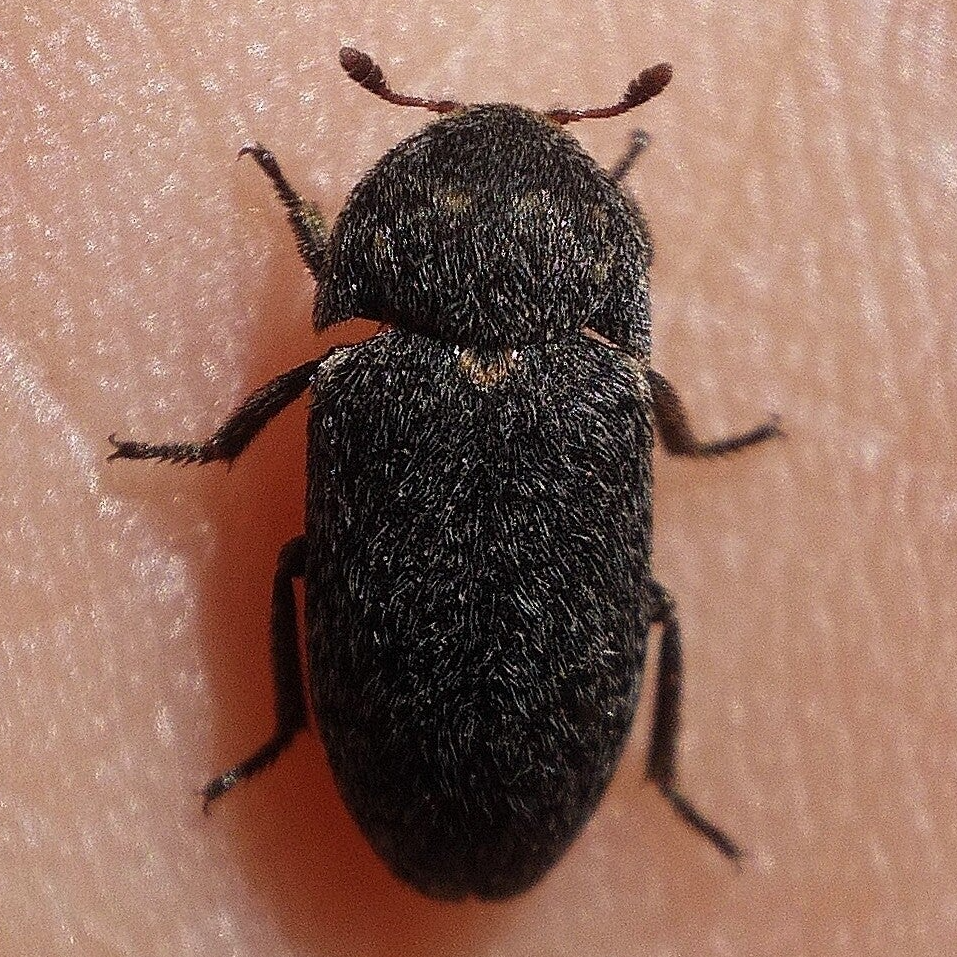
Image above: a regular Dermestes sardous.
By Guilherme Ramos on iNaturalist.
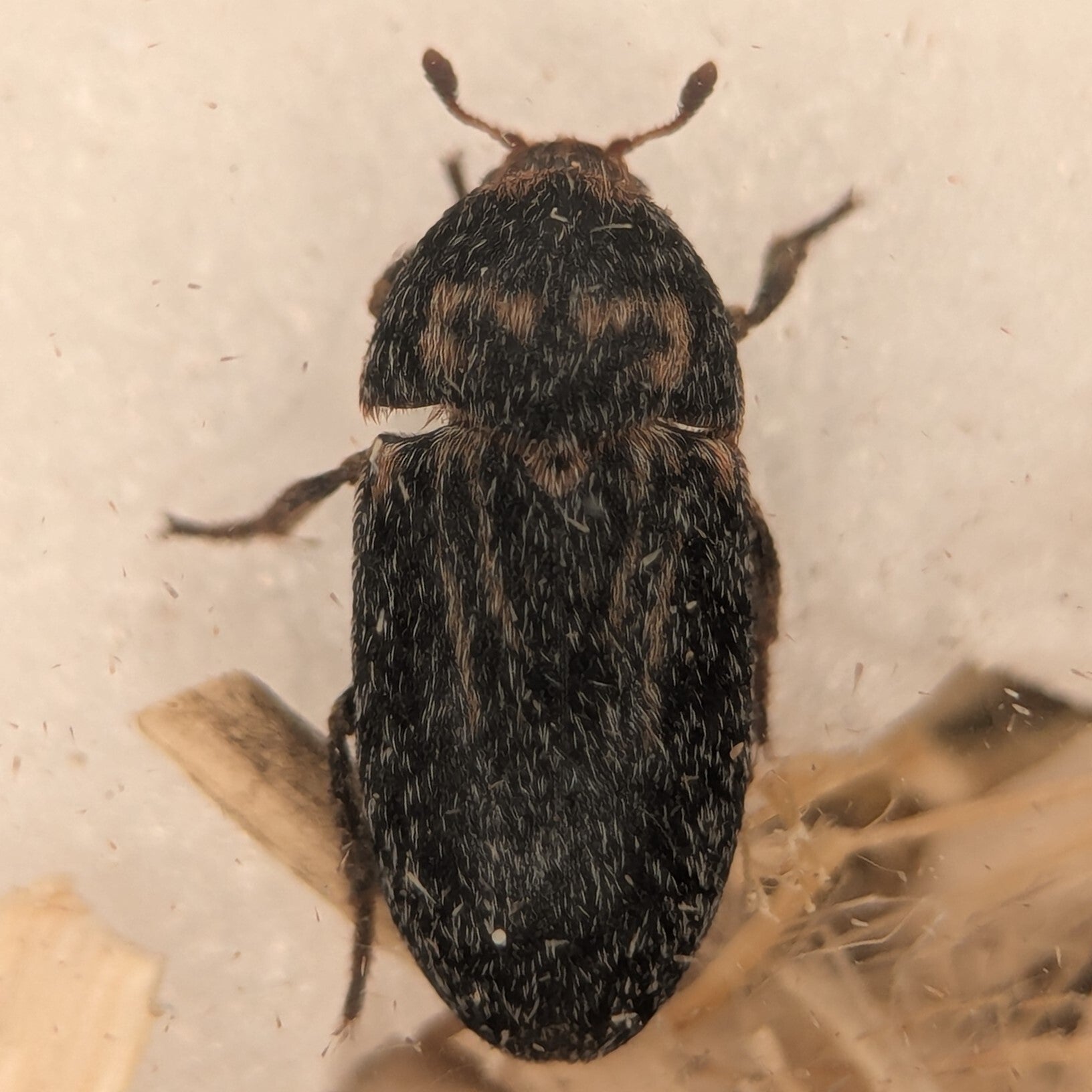
Photo above: the "fulvofasciatus" morph.
By Sarah Mahie
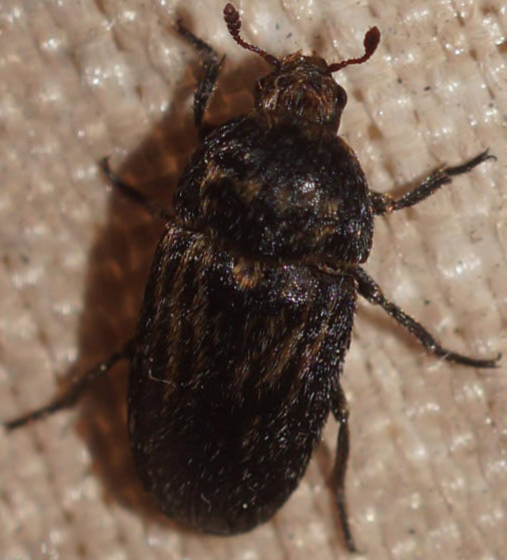
Photo above: the "striatellus" morph.
By C on BuigGuide
References:
-
Beal, R. S. 1994: Dermestes rattus (Coleoptera: Dermestidae): Taxonomic status and comparison with five closely related species in the Western United States. Entomological News 105: 27-32. Link.
-
BOLD 2021: Dermestes sardous. Specimen images. BIN: BOLD:AEF5693. Link.
-
Háva J. 2002: Descriptions of two new dermestid beetles (Coleoptera: Dermestidae) from Syria and Israel. Revue Suisse de Zoologie 109: 539-542. Link.
-
Háva J. 2025: Remarks on species of Dermestes Linnaeus, 1758, from the Palaearctic Region, with a new homonymy and two new synonymy (Coleoptera: Dermestidae). Folia Heyrovskyana, series A 33(2): 25-27. Link.
-
Reitter, E. 1908: Beschreibung einiger neuen Käferarten von Egypten. Bulletin de la Société Entomologique d’Egypte 1: 41-56. Link.
-
Shaw, M. R. 2007: A natural pabulum of Dermestes sardous Küster (Col., Dermestidae). The Entomologist's Monthly Magazine 143(1718-1720): 160. Link.
Add comment
Comments