

Subgenus: Montandonia
These are the dichotomous keys to identify larvae of the genus Dermestes (Coleoptera; Dermestidae) on a worldwide scale.
Click here to go back to the main page.
1a. 5th instar larva: Body flattened, tergites yellowish or pale rufous, their surface covered with very short, indistinct simple hairs. Long hairs of this type pointed, short hairs rounded or blunted apically (Fig. 1a-2). Labro-epipharyngeal margin of labrum covered with rather narrow spatula-shaped setae. Length of mandibles 1.7 times their maximum width; apical tooth narrow, pointed (Fig. 1a-4). Ante-costal sutures very fine, weakly sclerotized; tergites without spines. Legs rather short, length of fore tibio-tarsus and femur, respectively, 2.2 and 1.9 times their maximum width (Fig. 1a-5).
6th instar larva: Posterior margin of tergite IX with 2 small tubercles (rudiments of urogomphi) (Fig. 1a-3). Fore tibio-tarsus as in Fig 1a-4.
→ Dermestes depressus
1b. The appearance of other Montandonia larvae is unknown.
1a:
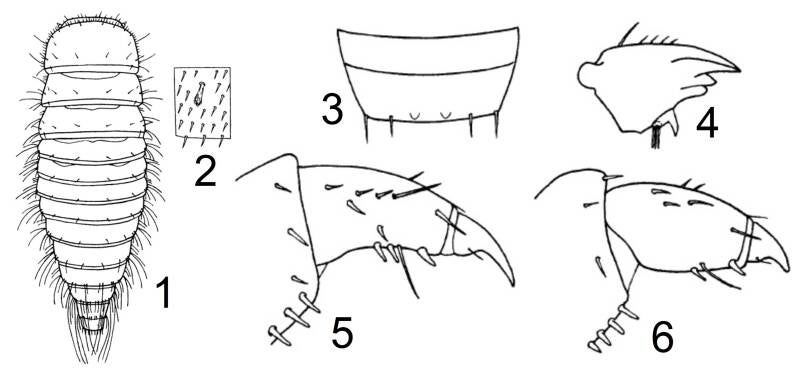
Dermestes depressus. 1, 2, 4 & 5: larva of 5th instar; 3 & 6: larva of 6th instar; 1: general view; 2: part of cuticle near posterior margin of mesothoracic tergite; 3: abdominal tergite IX with rudiments of urogomphi; 4: mandible; 5: fore tibio-tarsus (front view); 6: fore tibio-tarsus (front view).
Made by Sarah Mahie
Created on: 17-01-2026
Latest update: 20-01-2026