

Dermestes undulatus is a very common (and beautiful) species, but it still harbors surprises. In natural populations, a few individuals with a deviant appearance have been found. In 2020 Dermestidae expert Jiří Háva made a Facebook post showcasing a rare colour variability of this species.
In the comments underneath this post, Gábor Seres asked if a beetle photographed by J. Romsauer was the same colour variant - which got comfirmed by Háva. It seems the elytra are unusually densely covered with hairs, eliminating the typical mottled pattern of D. undulatus.

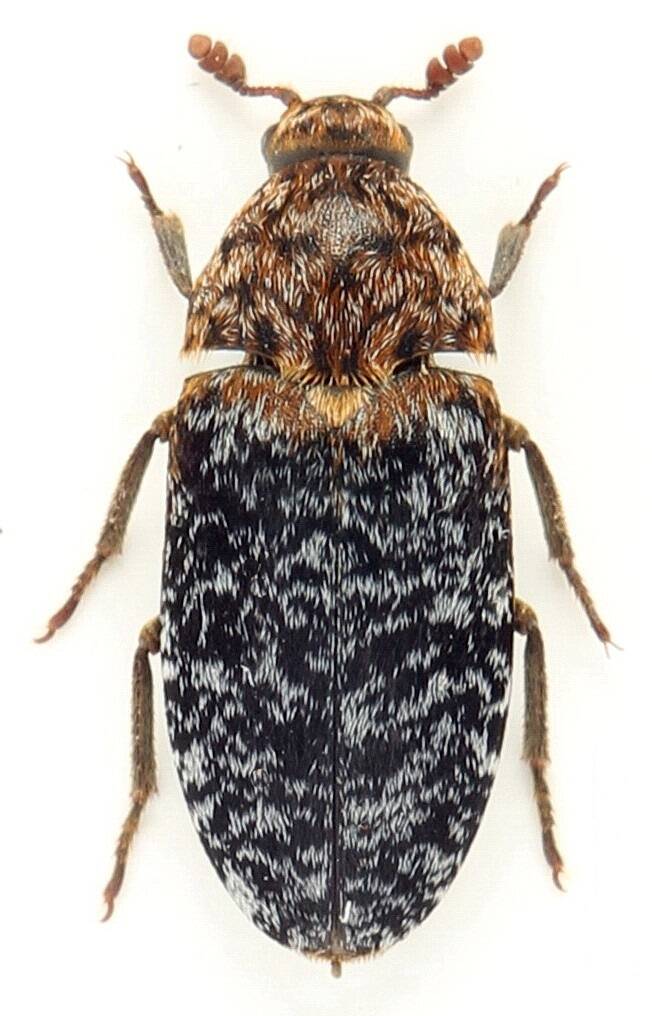
A similar morph can be found in the species Dermestes gyllenhali. The morph 'helmi' is often considered a subspecies (Háva, 2025), but other sources call it a variety (Lompe, 2025). I will call it the latter, since 'helmi' appears in the border area of the distribution of the nominal form of D. gyllenhali: it has been seen as south as in Croatia, as north as in the countries bordering the Baltic sea, but not in the centre of the European population (Herrmann, n.d.). It is a natural phenomena to see more colour mutations (either recessive or dominant) in individuals located in the edge of a population's distribution due to genetic drift.
A breeding experiment was conducted in 1935 with a few collected specimens of, at the time called, Dermestes helmi. The majority of the offspring were D. helmi, but also a few D. atomarius (a synonym of D. gyllenhali) appeared. With this experiment he determined that 'helmi' is only a variety of D. gyllenhali (Kniephof, 1935).
What is interesting, is that the experiment also proved that this variation is expressed by a dominant gene as a simple Mendelian trait. The result aligns with the theory that 1/4th of the offspring will inherit both recessive genes if both parents are heterozygous and 3/4th of the offspring will appear similar to the parents.
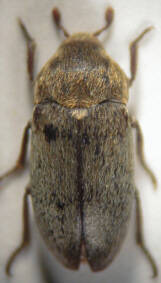

I don't think the colour variation of D. undulatus has been named yet. For the time being, I will use "helmi" to address this colour variation - due to the similarity with the helmi colour variation in D. gyllenhali. If the colour variation in D. undulatus is also caused by a dominant gene, it can simply be said that the trait currently isn't genetically present in my cultered populations. However, it can't hurt to keep an extra eye out for any spontaneous mutations - even if chances are small.
References:
- Háva, J. (2020). Facebook. Retrieved on: december 2025. Link.
- Háva, J. (2025). World Catalogue of the Dermestidae (Coleoptera). Subfamily: Dermestinae Latreille, 1804 (2025). Link.
- Herrmann, A. (n.d.). Dermestes picture gallery. Dermestes gyllenhali ssp. helmi REITTER, 1889. Retrieved on: december 2025. Link.
- Herrmann, A. (n.d.). Dermestes picture gallery. Dermestes gyllenhali ssp. gyllenhali Castelnau, 1840. Retrieved on: december 2025. Link.
- Lompe, A. (2025). Käfer Europas. Gattung Dermestes (V4.2.390-7). Retrieved on: december 2025. Link.
- Kniephof, J. (1935). Kleine coleopterologische Mittenlungen. Dermestes Helmi Rtt. Danzig. Entomologische Blätter, Krefeld 31: 125. Link.
Add comment
Comments