

Today I stumbled across this particular sighting on iNaturalist that shows multiple adult dermestid beetles of the species Dermestes maculatus inside a flower. At least six individuals! Huh?
The following photographs are made by Marienne de Villiers (2020) in South Africa. The flower in question is the species Hydnora africana and is also called jakkalskos or jackal food. These fleshy flowers are pollinated by dung and carrion beetles that are attracted to its carrion-like smell, and the flowers briefly trap the insects before letting them go covered in pollen. The species Dermestes maculatus accounted for 76.9% of the imprisoned insects during a study in Namibia (Bolin et al., 2009).
One of the commenters, Riaan Stals, connected the dots between the iNaturalist sighting and an article describing this exact phenomena on the website of The Botanical Society of America. More about this article below.


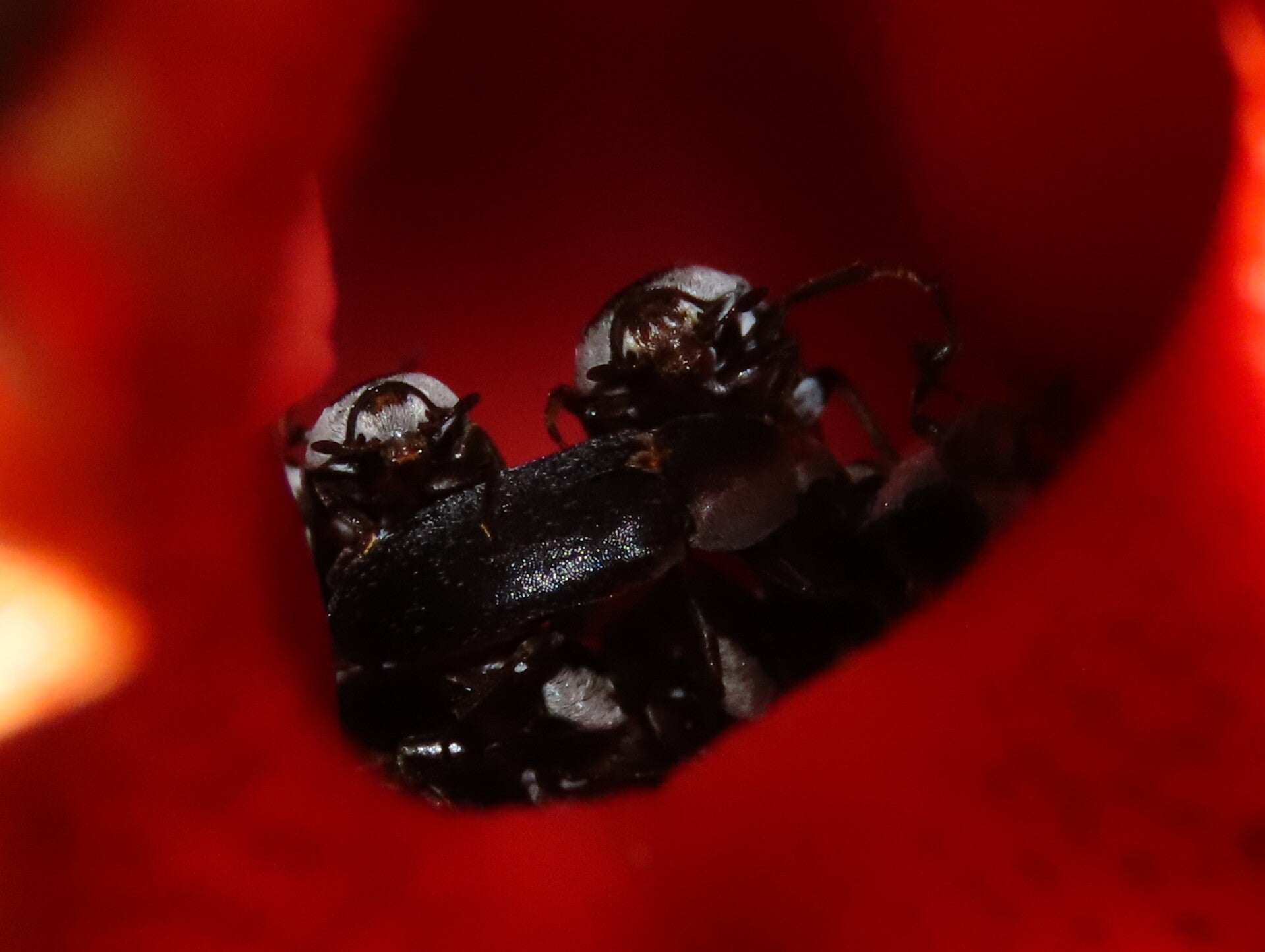
The four pictures above are made by Marienne de Villiers on iNaturalist.

The image above is from Sherwin Carlquist of the Botanical Society of America.
The author of this article, Sherwin Carlquist (2020), is not from Africa, but from the United States of America. She describes how the plant, cultivated in California, attracted local dermestid beetles (misidentified as dung beetles in the original article). The two species showcased in the article's photograph appear to be Dermestes frischii (top right) and Dermestes talpinus (lower left). The latter species is only found in North America (Háva, 2025), while jackal food is native to South Africa. That makes the number of Dermestes species that have been documented to make use of this flower at least three different species, including a species not found on this plant's continent of origin. That can only be called a border-crossing succes.
For the people that might consider this flower as an easy lure to attract dermestid beetles: Hydnora africana is a difficult plant to cultivate (Onszaden, n.d. 1). The main reason being the plant's parasitic lifestyle. Jackal food grows under the ground, with exception of the flowers, where it makes contact with the roots of the host plant: Euphorbia caput-medusae, also known as Medusa's head. Seeds of jackal food and it's host plant Medusa's head can be found online, for the one who is up to this challenge. Please let us know if you try and manage to lure local dermestids!
Some time later, I stumbled upon a photo made by Pedro Miguel (2025) in Portugal, also uploaded to iNaturalist. Four adult Dermestes frischii are seen inside the florescence of what appears to be Dracunculus vulgaris. Very similar photos were uploaded by Mimi Richardson (2023) to a Facebook group dedicated to the insects of south and west Western Australia. In these photos, an adult D. frischii is once again seen inside the florescence of D. vulgaris.
It is noteworhy how often this species is found in these flowers: D. frischii was also found inside the florescence of both Dracunculus creticus and D. vulgaris in Creta and the species was found inside a D. vulgaris florescence in Washington (Meeuse 1959). D. frischii was found on a D. vulgaris flower in Italy (Williams, 2021) and in Greece (Steiblys, 2022). In Gibraltar, both Dermestes undulatus and D. frischii were captured within the flower of D. vulgaris (Meeuse, 2009). D. undulatus was also found on a D. vulgaris flower in Italy (bracchettogiallo, 2020).
Christopher Rogers (2009) noted that he witnessed Dermestes marmoratus, a North American species (Háva, 2025), pollinating Dracunulus - and that he also saw this species pollinating Helicodiceros and Arum. In all instances the dermestid beetles were attracted to the flowers by the emitted odour. The smell of both Dracunculus and Helicodiceros are described as rotting carrion (Onszaden, n.d. 2; Stensmyr et al., 2003), wheras different Arum species mimick various types of dung (Kite et al., 1998).
Sometimes beetles of the genus Dermestes seem to mistake the smell of dung for carrion, since Dermestes tulpinus was found under a cat scat (Murray, 2006), Dermestes fasciatus was found on a coyote scat (Eaton, 2016) and D. frischii was found on a fresh fox scat (Suecee, 2015). Note that all the scats belong to carnivores, so perhaps the smell is rich of decaying animal proteins. However, the same can't be said for the three adult Dermestes caninus that were found on a cow patty (Dibley, 2025).
The species Dermestes aurichalceus (Háva, 2025) is often found in the nests of processionary caterpillars and it is suspected by Perris (1853) that the beetle larvae also feed on the excrement of the caterpillars. Perris also mentions in the same paper that he witnessed the larvae of Dermestes lardarius feeding on the excrements of silkworms inside vacant cocoons.
However, not every visit to flowers can be explained by the attraction of odour. Sandro Kiladze (2025) uploaded a photo of Dermestes kaszabi covered in pollen to iNaturalist. The flowers the beetle walks on seem to be yellow umbellifers located in Georgia. Pollen are also visible on the Dermestes coronatus that was photographed by Kazenas (2017) on a yellow dandelion species located in Kazakhstan. It is known from the subgenus Dermestes that some species can digest some plant based materials such a grains, but the two mentioned species are from the subgenus Dermestinus (Robinson, 2005; Hava, 2025).
Pietro Niolu (2007) uploaded photos of Dermestes hirticollis to Flickr. In multiple photos, the beetle is seen on white flowers. It is known from the closely related species Dermestes depressus that the larvae also feed on the pollen that are present inside bumble bee nests (Zhantiev, 2001).

The image above is made by Pedro Miguel.

The image above is made by Mimi Richardson.

The image above is made by bracchettogiallo.
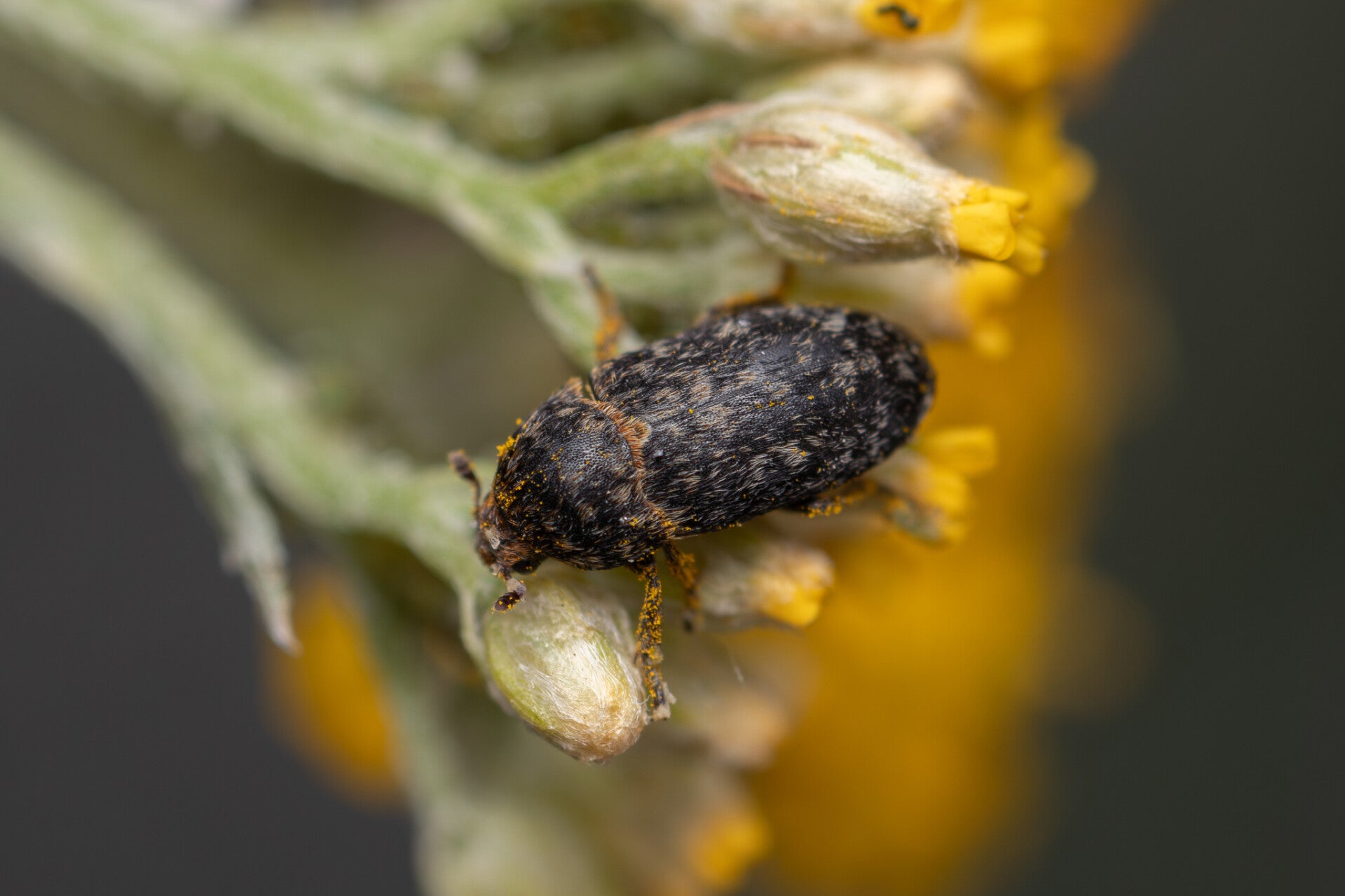
The image above is mage by Sandro Kiladze on iNaturalist.

The image above is made by Kazenas on Macroid.

The image above is made by Pietro Niolu on Flickr.
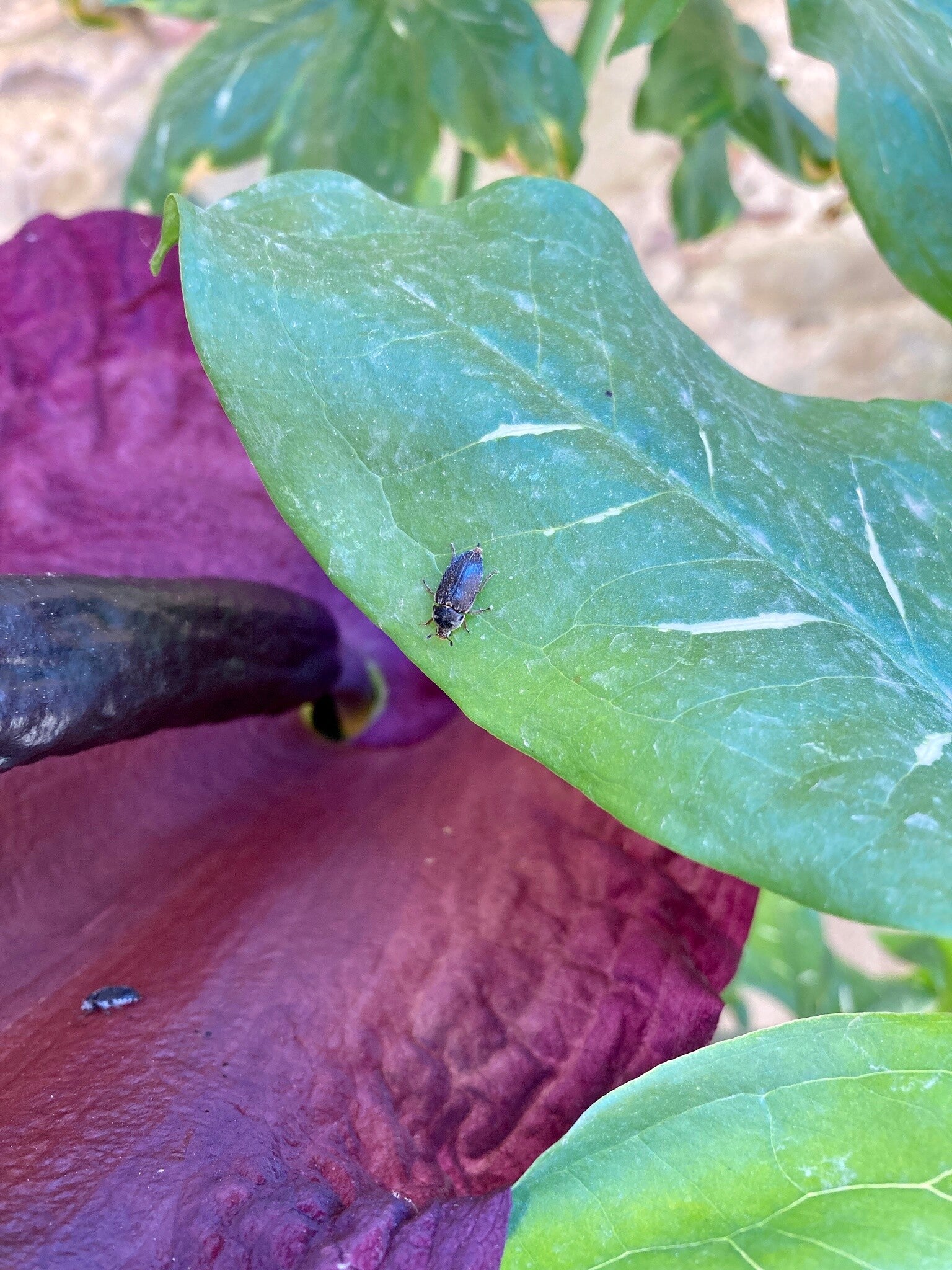
The image above is made by Nicholas Moray Williams.

The image above is from the study of Bolin et al. 2009.
References:
- Bolin, J. F.; Maass, E.; Musselman, L. J. (2009). "Pollination biology of Hydnora africana Thunb. (Hydnoraceae) in Namibia: Brood-site mimicry with insect imprisonment". International Journal of Plant Sciences. 170 (2): 157–163. DOI:10.1086/593047
- bracchettogiallo 2020: iNaturalist: subgenus Dermestinus. Link
- Carlquist, S. (2020). The Botanical Society of America: BSA Parasitic Plant Pages, Hydnora africana. Link
- Dibley A. (2025). iNaturalist: Dermestes caninus. Link.
- Eaton E. R. (2016). Bug Eric: What's in Dat Scat? Link
- Háva, J. (2025). World Dermestidae. Subfamily: Dermestinae Latreille, 1804. Link
- Kazenas (2017). Macroid: Dermestes coronatus Steven in Schönherr, 1808. Link.
- Kilidatze, S. (2025). iNaturalist: Dermestes kaszabi. Link
- Kite, C. C., Hetterscheid, W., Lewis, M. J., Boyce, P., Ollerton, J., Cocklin, E., Diaz, A. & Simmons, M. S. J. (1998). Inflorescence odours and pollinators of Arum and Amorphophallus (Araceae). Reproductive Biology in Systematics, Conservation and Economic Botany. Royal Botanic Gardens, Kew, 295-315. Link
- Meeuse, J. D. (1959). Kevers als bestuivers van Araceeën. De Levende Natuur 62(10): 217-226. Link
- Miguel, P. (2025). iNaturalist: Complex Dermestes maculatus. Link
- Murray, T. (2006) BugGuide: beetle - Dermestes talpinus. Link
- Niolu P. (2007). Flickr: Dermestes hirticollis. Link.
- Onszaden (n.d. 1). Jackal Food (Hydnora africana). Retrieved on: december 2025. Link
- Onszaden (n.d. 2). Drakenwortel (Dracunculus vulgaris). Retrieved on: january 2026. Link
- Richardson, M. (2023) Facebook: Insects of Perth & South West Western Australia. Link
- Robinson, W. H. (2005). Urban insects and Arachnids. A Handbook of Urban Entomology. Cambridge University Press, Cambridge, UK, 472 p. Link.
- Rogers, C. (2009). hort.net: Re: dermestid beetles and pollination. Link
- Steiblys G. (2022). Facebook: Coleoptera. Link.
- Stensmyr, M. C., Urru, I., Collu, I., Celander, M., Hansson, B. & Angioy, A-M. (2003). Pollination: Rotting smell of dead-horse arum florets. Nature 420(6916): 625-626. DOI:10.1038/420625a
- suecee (2025). iNaturalist: Dermestes frischii. Link
- de Villiers, M. (2020). iNaturalist: Dermestes maculatus. Link
- illiams N. M. (2021): iNaturalist: Dermestes frischii. Link.
- Zhantiev, R. D. (2001). Larvae of dermestid beetle of the genus Dermestes (Coleoptera, Dermestidae) from Russia and adjacent countries. Montandonia subgenus. Link.
Article updated on: 04-02-2026
Add comment
Comments