

Dermestes undulatus is a very common (and beautiful) species, but it still harbors surprises. In natural populations, a few individuals with a deviant appearance have been found. In 2020 Dermestidae expert Jiří Háva made a Facebook post showcasing a rare colour variability of this species.
In the comments underneath this post, Gábor Seres asked if a beetle photographed by J. Romsauer was the same colour variant - which got comfirmed by Háva. It seems the elytra are unusually densely covered with grey hairs, eliminating the typical mottled pattern of Dermestes undulatus.

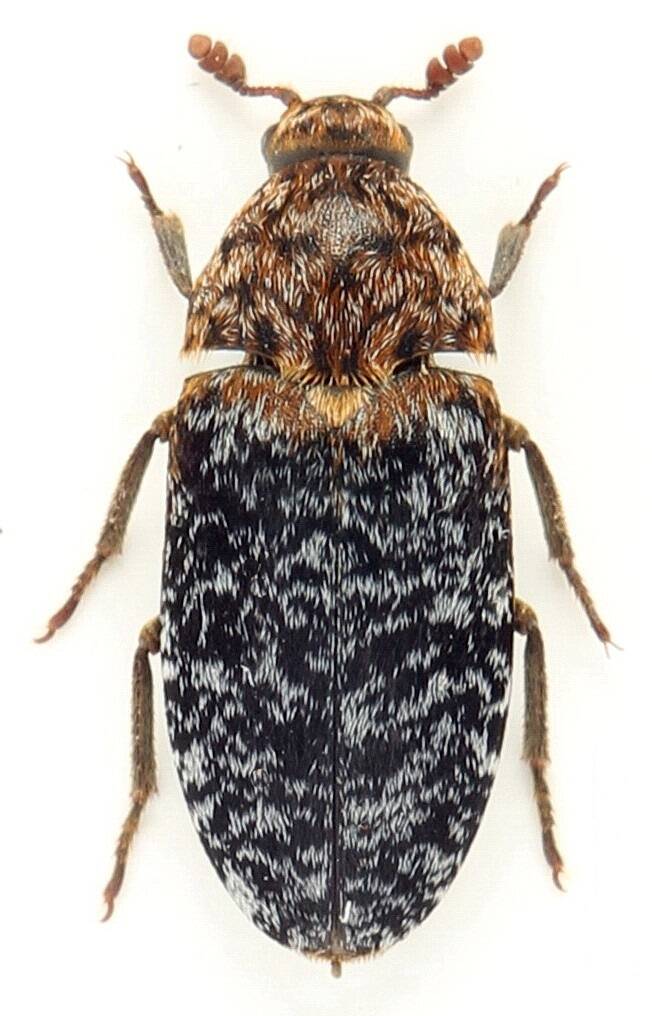
A similar morph can be found in the species Dermestes gyllenhali. The morph 'helmi' is often considered a subspecies (Háva, 2025), but other sources call it a variety (Lompe, 2025). I will call it the latter, since 'helmi' appears in the border area of the distribution of the nominal form of D. gyllenhali: it has been seen in Croatia, in the countries bordering the Baltic sea, but not in the centre of the European population (Herrmann, n.d.). It is a natural phenomena to see more colour mutations (either recessive or dominant) in individuals located in the edge of a population's distribution due to genetic drift.
A breeding experiment was conducted in 1935 with a few collected specimens of the species Dermestes helmi. The result of the breeding was a majority of D. helmi and fewer D. atomarius (synonym of the D. gyllenhali). With this experiment he determined that 'helmi' is only a variety of D. gyllenhali (Kniephof, 1935).
What is interesting, is that the experiment also proved that this variation is expressed by a dominant gene. The fact that a smaller fraction of regular D. gyllenhali were born from D gyllenhali var. helmi parents, aligns perfectly with the theory that 1/4th of the offspring will inherit both recessive genes if both parents are heterozygous and 3/4th of the offspring will appear similar to the parents.
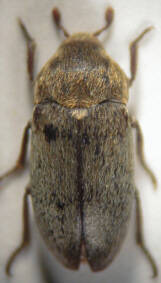

I don't think the colour variation of D. undulatus has an official name yet. For the time being, I will use "helmi" to address this colour variation - in honor of the D. gyllenhali colour variation. If the colour variation is in D. undulatus also caused by a dominant gene, then I can simply say that the trait isn't genetically present in my cultered populations. However, I can conduct a breeding experiment to see if the colour morph in D. undulatus is perhaps hiding as a recessive trait within my colony.
This post is on-going and will be updated with new information when available.
References:
- Háva, J. (2020). Facebook. Retrieved on: december 2025. Link.
- Háva, J. (2025). Dermestidae World Catalogue. Link.
- Herrmann, A. (n.d.). Dermestes picture gallery. Dermestes gyllenhali ssp. helmi REITTER, 1889. Retrieved on: december 2025. Link.
- Herrmann, A. (n.d.). Dermestes picture gallery. Dermestes gyllenhali ssp. gyllenhali Castelnau, 1840. Retrieved on: december 2025. Link.
- Lompe, A. (2025). Käfer Europas. Gattung Dermestes (V4.2.390-7). Retrieved on: december 2025. Link.
- Kniephof, J. (1935). Kleine coleopterologische Mittenlungen. Dermestes Helmi Rtt. Danzig. Entomologische Blätter, Krefeld 31: 125. Link.
Add comment
Comments